
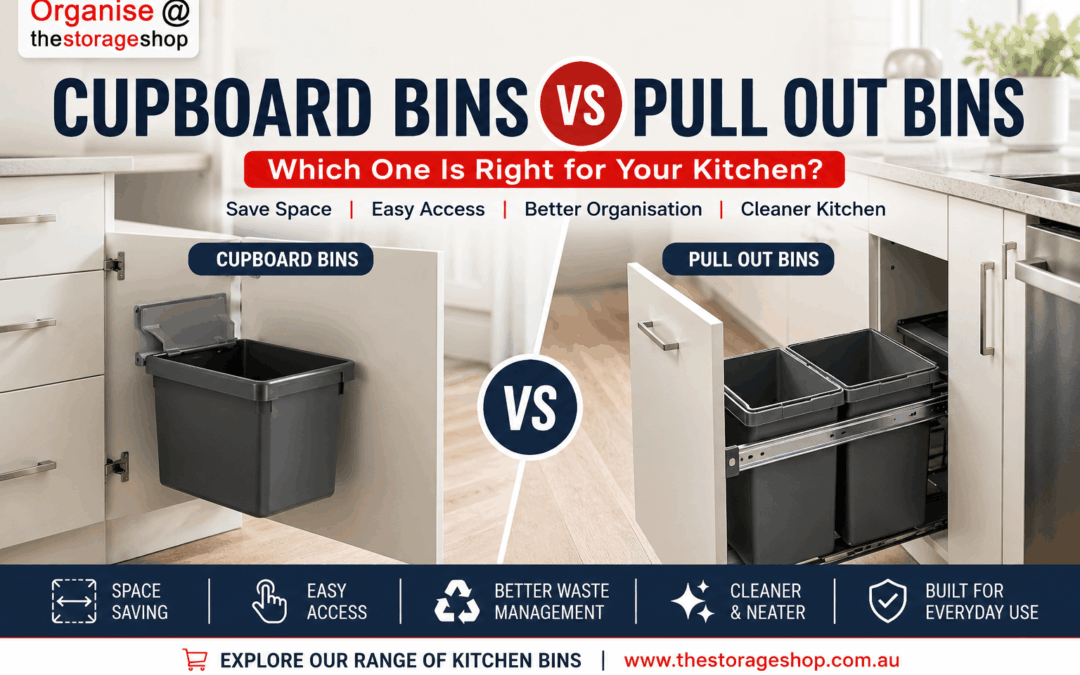
A good kitchen bin should make everyday clean-up easier, not get in the way. In many homes the problem isn’t the rubbish itself — it’s where the bin sits, how easy it is to reach, and whether it helps or disrupts the kitchen layout.
That’s why many Australian households are moving away from visible freestanding bins and choosing hidden cabinet solutions instead. Cupboard bins and pull out bins both keep waste out of sight, but they work differently and suit different kitchens.
This guide compares both options clearly — with real capacities and cabinet sizes — so you can decide which bin is right for your cabinet size, household routine, recycling habits and available space.
You can also browse the full range of kitchen bins at The Storage Online Shop, including pull out bins, cupboard bins, under sink bins, door mounted bins, pedal bins and freestanding options.
Quick Answer: Should You Choose a Cupboard Bin or a Pull Out Bin?
Choose a cupboard bin if you want a compact, simple and discreet waste solution for a small kitchen, food scraps or light daily rubbish — they typically hold around 5L–12L and fit narrow cabinets.
Choose a pull out bin if you want easier access and more capacity — singles run from about 12L to 35L and doubles up to 2×35L — ideal for a base cabinet 400mm or wider and busy households that sort recycling.
For most everyday kitchens with a suitable cabinet, a pull out bin is the more convenient long-term choice. For very tight spaces or secondary waste areas, a cupboard bin is the smarter fit.
What Is a Cupboard Bin?
A cupboard bin is a bin that sits or mounts inside a kitchen cabinet, so rubbish stays hidden behind a cupboard door instead of sitting on the floor.
Cupboard bins come in a few styles. Some sit loose inside the cabinet, some attach to the inside of the cupboard door and swing out as it opens, and others are shaped for compact areas such as under the sink or beside a prep zone. Door-mounted versions are the most common and usually hold around 5L–12L.
The purpose is simple: keep waste out of sight without using valuable floor space. Cupboard bins suit kitchens where you want a neat finish but don’t need a large bin system — they work well for food scraps, small households, apartments, butler’s pantries, laundry cupboards and secondary waste areas.
What Is a Pull Out Bin?
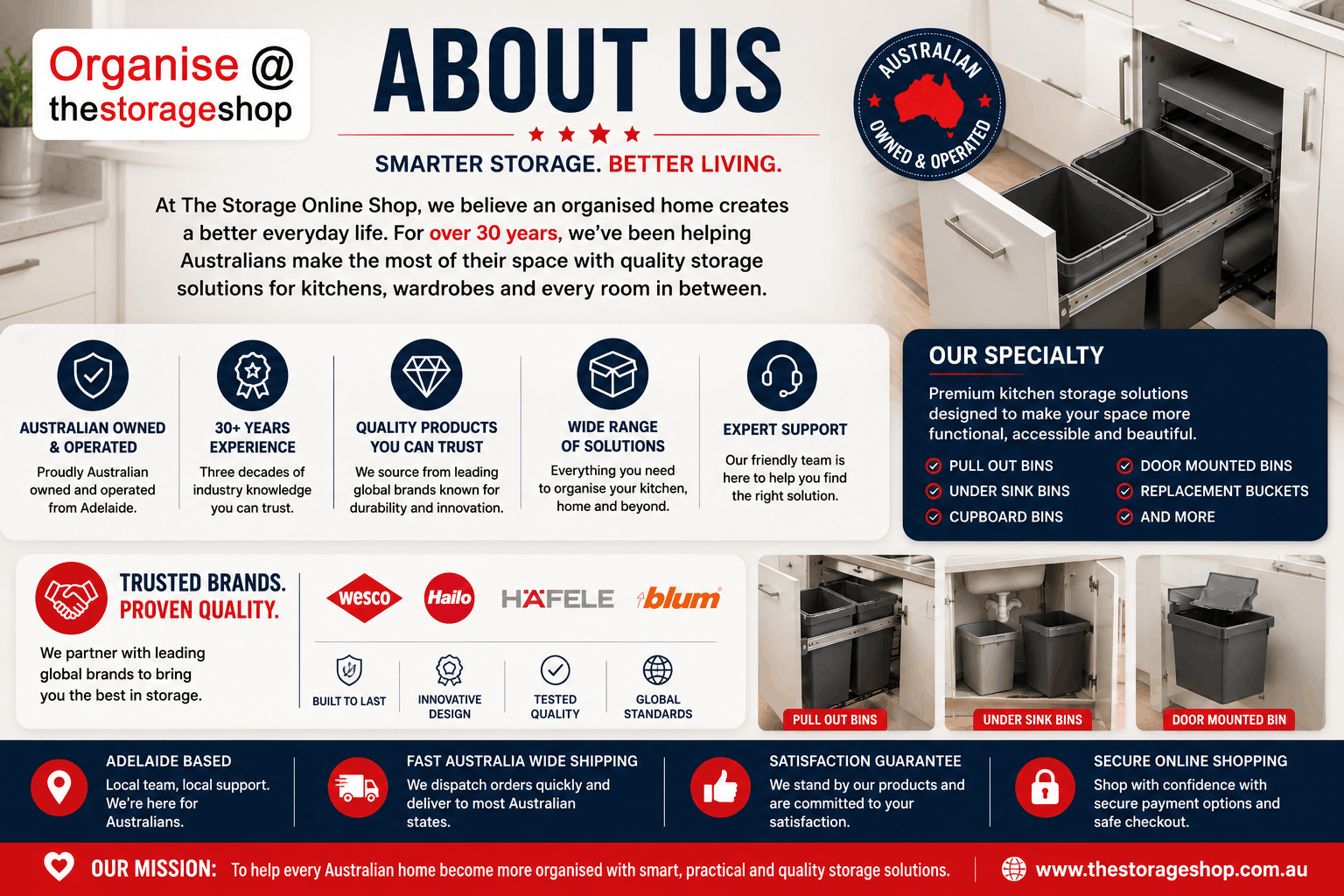
A pull out bin is a cabinet bin that slides out towards you on runner rails. Instead of opening a cupboard and reaching inside, you pull the bin forward so the bucket is right in front of you, fully clear of the cabinet.
Pull out bins are popular in modern kitchens because they feel integrated — hidden when not in use, easy to reach when cooking, cleaning or clearing plates. They come in single-bin and double-bin designs: a single (around 12L–35L) handles general waste, while a double (from 2×15L up to 2×35L) separates rubbish and recycling in one cabinet.
The quality of a pull out bin lives in its runners. Full-extension, soft-close rails are what make the bin glide smoothly, carry a full load without sagging and close quietly. If you use your kitchen bin many times a day, a pull out system makes the routine noticeably smoother. Browse the configurations in the pull out bin range.
Cupboard Bins vs Pull Out Bins: Simple Comparison
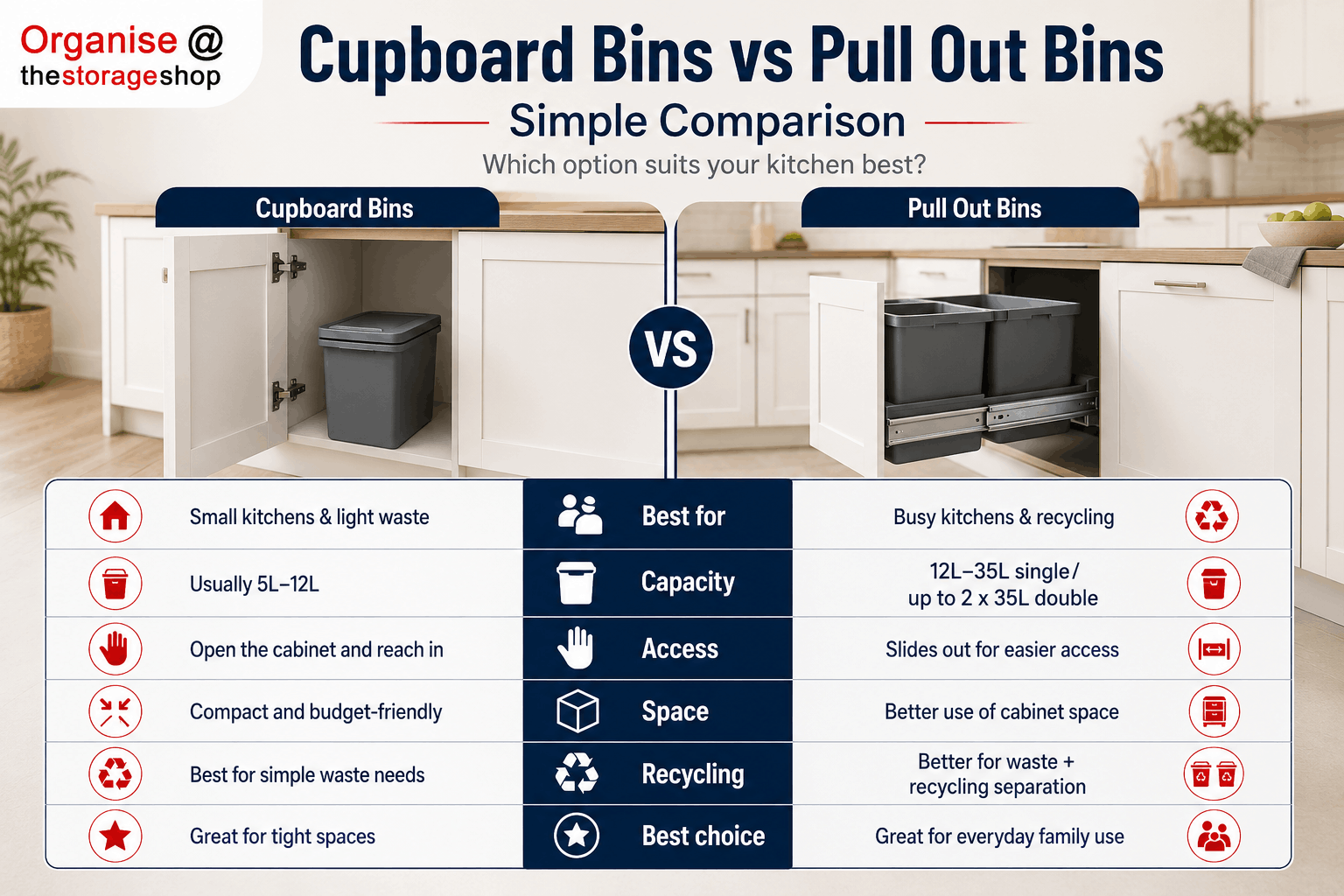
| Feature | Cupboard Bin | Pull Out Bin |
| Best for | Small spaces, food scraps, light waste | Everyday waste, recycling, busy kitchens |
| How it moves | Swings out with the cabinet door | Slides straight out on runner rails |
| Typical capacity | Around 5L–12L | 12L–35L single; up to 2×35L double |
| Best cabinet width | Fits narrow cabinets, including under 300mm | 400mm and up (300mm fits a slim single) |
| Access | Open the door and place waste inside | Full extension — open top, nothing hidden |
| Recycling | Limited; usually a single bucket | Better — twin and triple systems available |
| Cleaning | Easy if the bucket lifts out | Easy — most buckets are removable |
| Installation | Simple — a few holes and a screwdriver | Moderate — runners must be aligned and fixed |
| Price guide | Entry to mid | Mid to higher |
| Best household | Singles, couples, compact kitchens | Families, renovators, frequent cooks |
Which Bin Is Better for Everyday Kitchen Use?
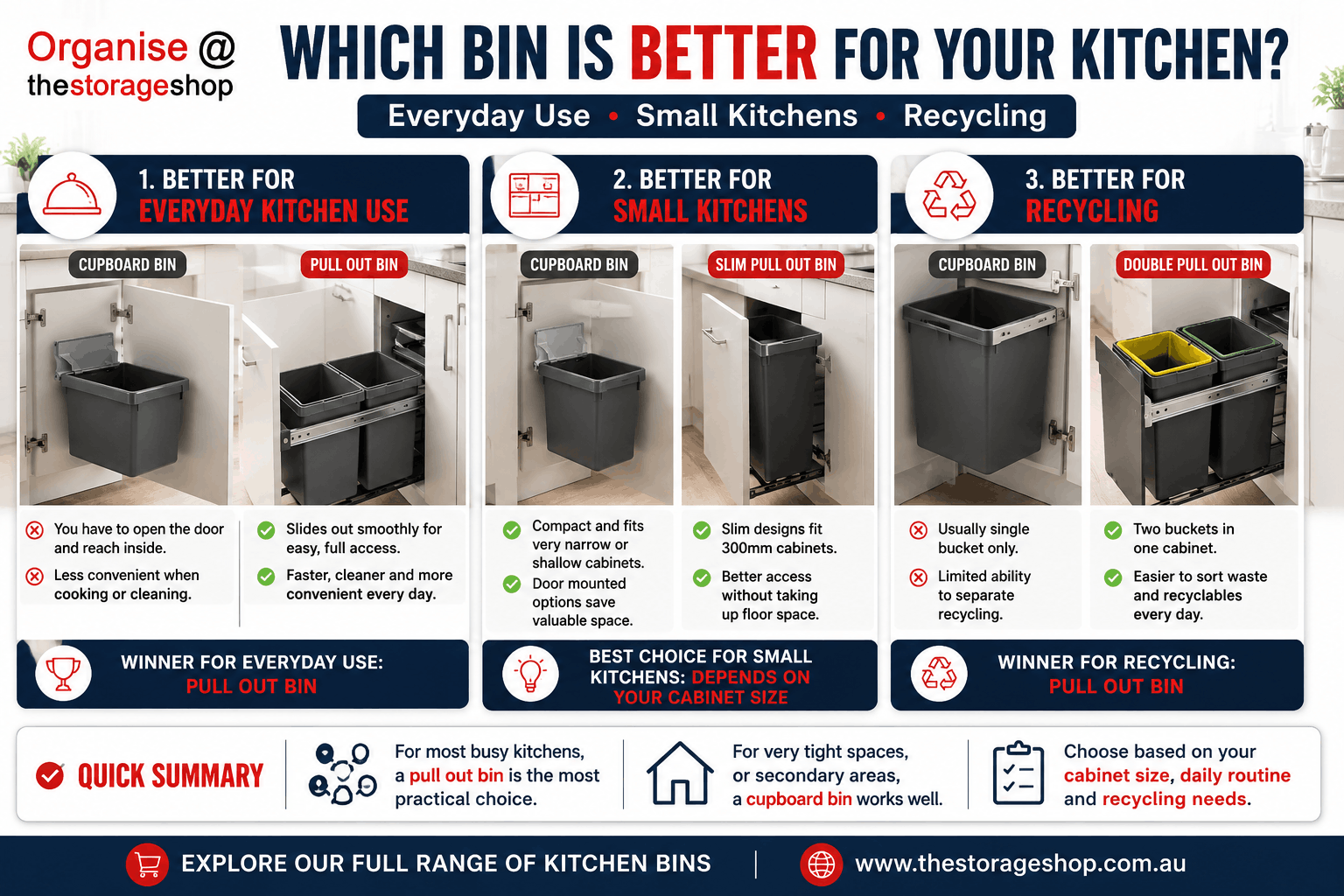
For everyday use, a pull out bin has the clear advantage.
When you’re cooking dinner, clearing breakfast or unpacking groceries, you don’t want to bend down, reach into a dark cabinet or aim into a small opening. A pull out bin comes forward with an open top, making it easy to scrape plates, change liners and access the bucket. That matters most in kitchens where the bin gets used many times a day, so families, shared homes and people who cook often will find it more practical.
A cupboard bin still works well for lighter use. If you only need a small bin for vegetable scraps near your benchtop, a compact door-mounted bin is enough. But for the main kitchen waste station, a pull out bin is the easier, more efficient choice.
Which Bin Is Better for Small Kitchens?
Small kitchens need careful planning — every cabinet, drawer and corner has to earn its place.
A cupboard bin is a strong option when space is extremely limited. It keeps rubbish hidden, uses no floor area, and a door-mounted version fits cabinets too shallow or narrow for a sliding frame. But a slim pull out bin also works beautifully in a small kitchen if you have the right cabinet — a 300mm cabinet will take a compact single of roughly 12L–15L, giving you better access than a door-mounted bin without a freestanding bin on the floor.
The best choice comes down to your cabinet measurements: internal width, depth and height, plus hinge position and whether the door opens fully. For layout-specific ideas, read our guide to the best pull out bins for small kitchens — especially useful for a narrow cabinet, apartment kitchen or galley layout.
Which Bin Is Better for Recycling?
If recycling matters in your home, a pull out bin is the better option.
A double pull out bin gives you two buckets inside one cabinet — typically 2×15L up to 2×35L — so general waste goes in one and recycling in the other, both sliding out together in a single motion. That keeps sorting easy and everything hidden in one place.
A cupboard bin can support recycling, but it usually depends on space. A small cabinet may only fit one compact bucket, which is fine for food scraps or general rubbish but rarely enough for a household separating paper, plastic, glass and general waste. When separation is effortless, people actually do it — which is why a dual pull out bin works so well for families and busy kitchens.
Which Option Looks Better in a Modern Kitchen?
Both bins improve the look of a kitchen by removing visible rubbish from the floor, but pull out bins tend to suit modern designs better because they read as part of the cabinetry.
Everything is hidden, smooth and easy to use, and you can position the bin right by the sink, dishwasher or prep area for a cleaner workflow. Cupboard bins are also neat, but they’re a more basic solution — ideal when you want hidden storage without changing much inside the cabinet. If you’re renovating, building or upgrading your storage, a pull out bin is the more polished result.
Which Bin Is Easier to Clean?
A bin that’s hard to clean quickly becomes a daily frustration, and here pull out bins have the edge.
Because the bucket slides out and usually lifts free, a pull out bin makes it simple to change liners, wipe around the frame, clean spills and empty waste. A cupboard bin is also easy to maintain when the bucket is removable, but if it sits deep inside the cabinet, cleaning around it is less convenient. Whichever you choose, look for removable buckets, smooth surfaces, sturdy handles and easy liner access — and stainless steel if you want the best resistance to odours and stains.
What Size Kitchen Bin Do You Need?
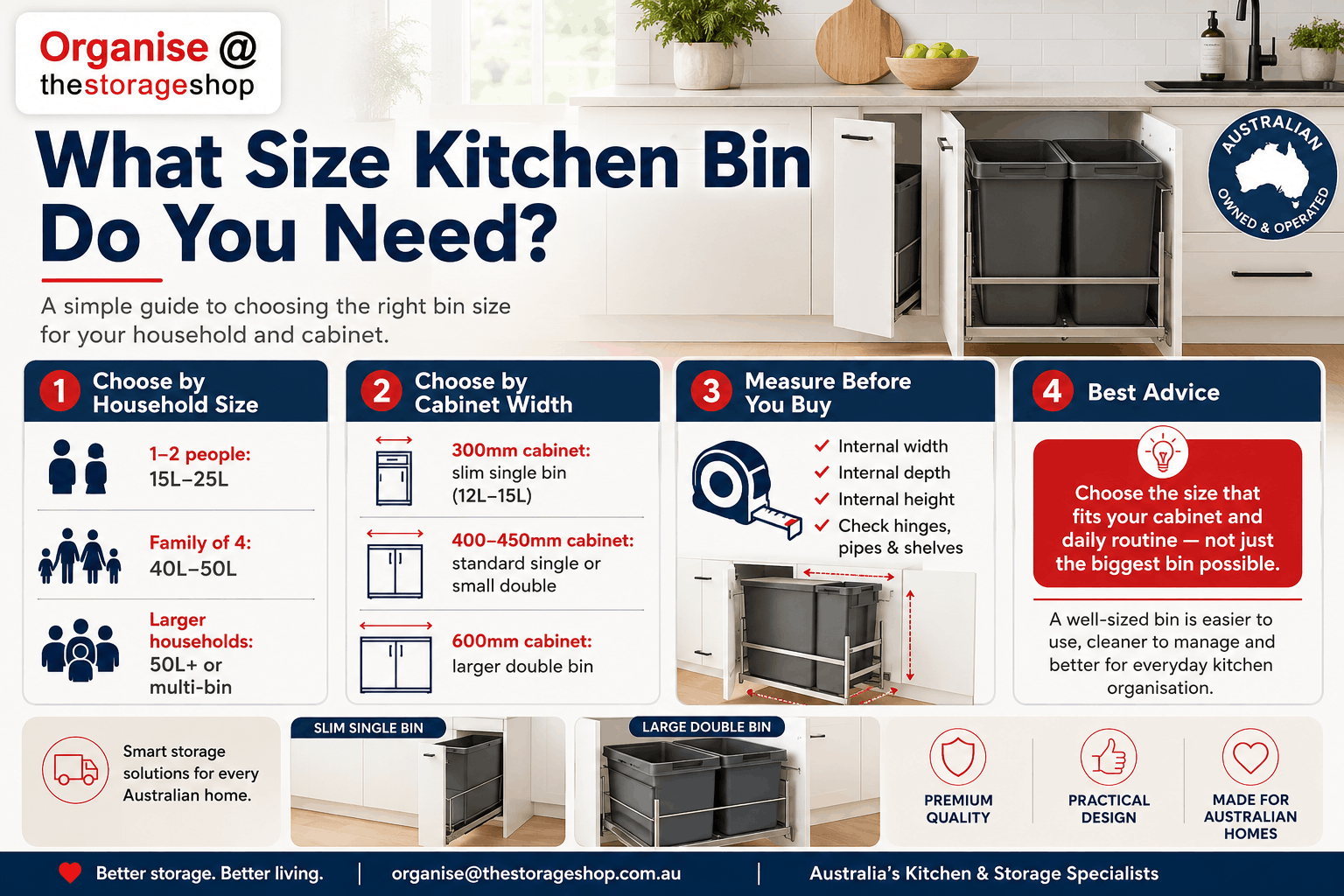
The right size depends on your household, not the biggest bin that fits. As a practical starting point: a single person or couple is well served by around 15L–25L, a family of about four suits a medium 40L–50L bin (often a twin system), and larger households or keen entertainers should look above 50L or to multi-compartment setups.
Before choosing a cupboard or pull out bin, measure the inside of the cabinet — not the door, which is often several centimetres wider:
- Internal cabinet width — 300mm suits a slim single (~12L–15L), 400–450mm a standard single or small double, 600mm a large double
- Internal cabinet depth — so the bin clears the door when closed
- Internal cabinet height — allowing for the bin plus any lid or odour trap
- Clearance for hinges, and for the runners on a pull out
- Whether any shelves need to be removed
For a full breakdown of every bin type and sizing scenario, our complete guide to kitchen bins goes deeper than we can here.
Can You Install a Bin Under the Sink?
Yes — but the under sink cabinet is the one space where measuring matters most, because plumbing eats into it.
Waste pipes, water connections and the base of the sink bowl all reduce the usable height and depth, so the deciding factor is clearance around the plumbing rather than the cabinet’s outer size. A compact cupboard bin suits a tight under sink space, while a slim pull out bin works if there’s enough clear depth in front of the pipework. Measure from the cabinet floor to the lowest part of the sink or pipes, and the clear depth from the cabinet front to the plumbing, before you order.
Which Costs More — a Cupboard Bin or a Pull Out Bin?
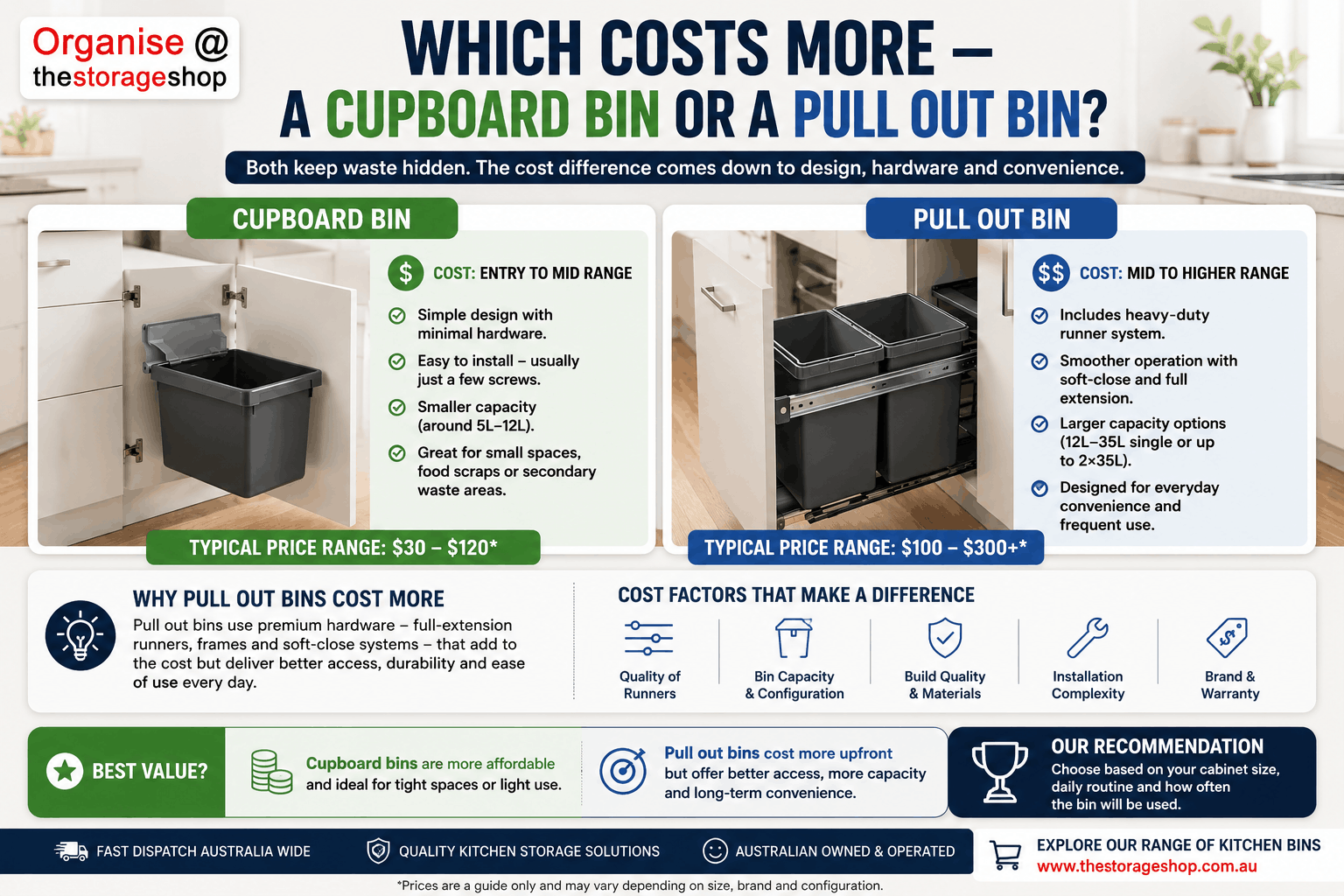
Cupboard bins generally cost less because they use simpler hardware. Pull out bins usually cost more because they include runners, frames and sliding mechanisms. Entry-level pull out bins may sit in the lower price range, while larger double, triple and drawer-style systems cost more. The best approach is to choose by cabinet fit, capacity and runner quality rather than price alone.
The part worth spending on is the runners, since cheap rails are where budget bins fail first by sticking and sagging under a full load. Brands trusted by cabinet makers — from trusted kitchen storage brands available in our range — build their reputation on that hardware, which is why a slightly higher upfront price often works out cheaper over the life of the bin. Prices move with sales and stock, so check the current figure on each product page before deciding.
When Should You Choose a Cupboard Bin?
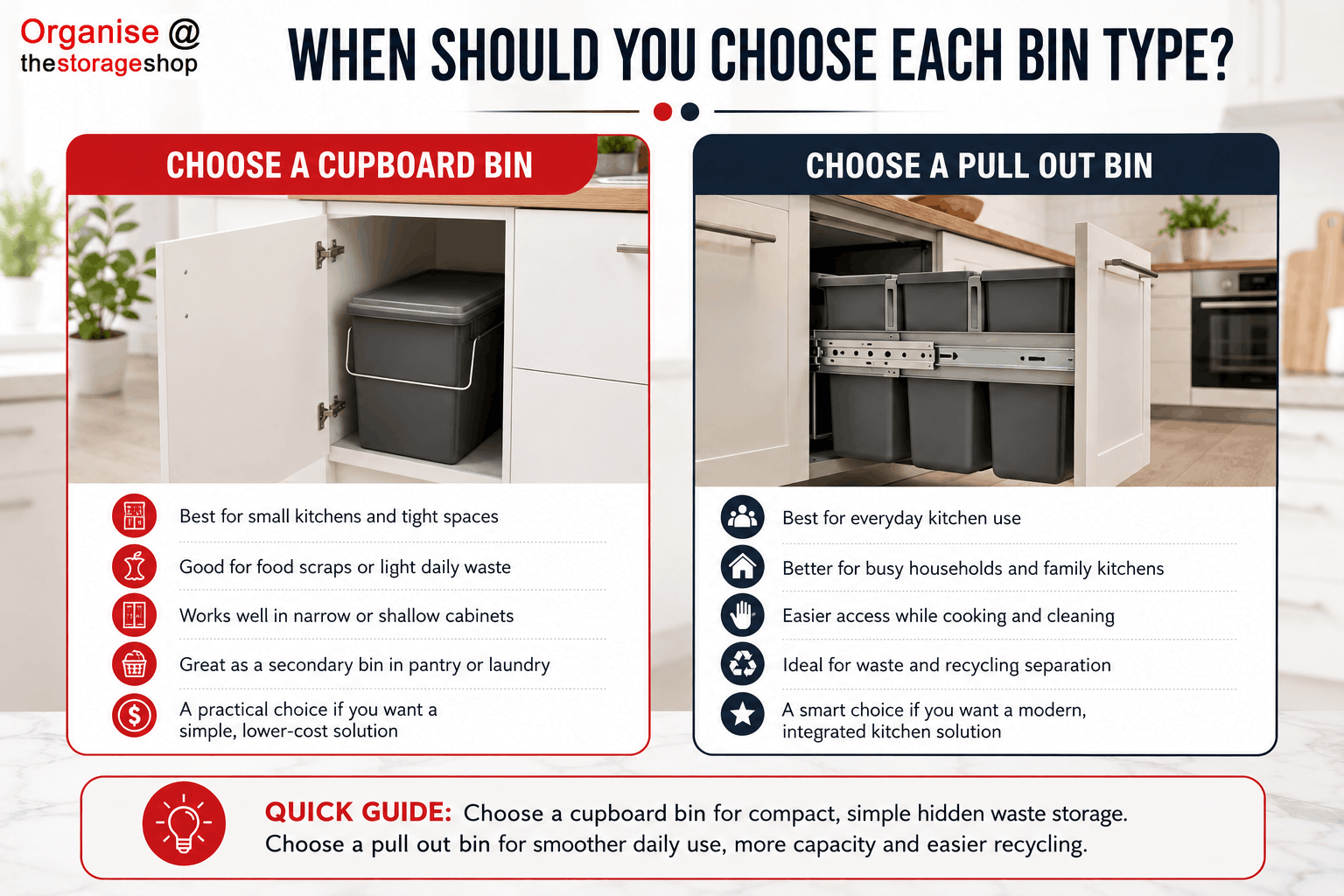
A cupboard bin is the right choice if your kitchen is compact, your cabinet space is limited, or you only need a small hidden bin.
Lean cupboard bin if:
- You want a simple, discreet hidden waste solution
- You have a small kitchen or apartment
- You need a bin for food scraps near the prep area
- You don’t need large capacity (5L–12L is plenty)
- You want to keep waste off the floor
- You need a secondary bin in a pantry or laundry
- You have limited cabinet depth or a narrow cabinet
- You want a practical option without a major cabinet upgrade
Cupboard bins are ideal for people who want function without overcomplicating the kitchen — simple, discreet and useful in many areas of the home.
When Should You Choose a Pull Out Bin?
A pull out bin is the better option if the bin is used frequently and you want a smoother daily routine.
Lean pull out bin if:
- You want easier, full-extension access
- You cook often
- You need larger capacity (up to 35L single, 2×35L double)
- You want to separate rubbish and recycling
- You’re upgrading your kitchen storage
- You dislike visible freestanding bins
- You want removable buckets for easy cleaning
- You have a suitable base cabinet (400mm or wider is ideal)
Pull out bins work especially well placed near the sink, dishwasher or main prep area, creating a practical workflow because waste clears quickly as you cook or clean.
Cupboard Bin or Pull Out Bin: Which Is Better for Families?
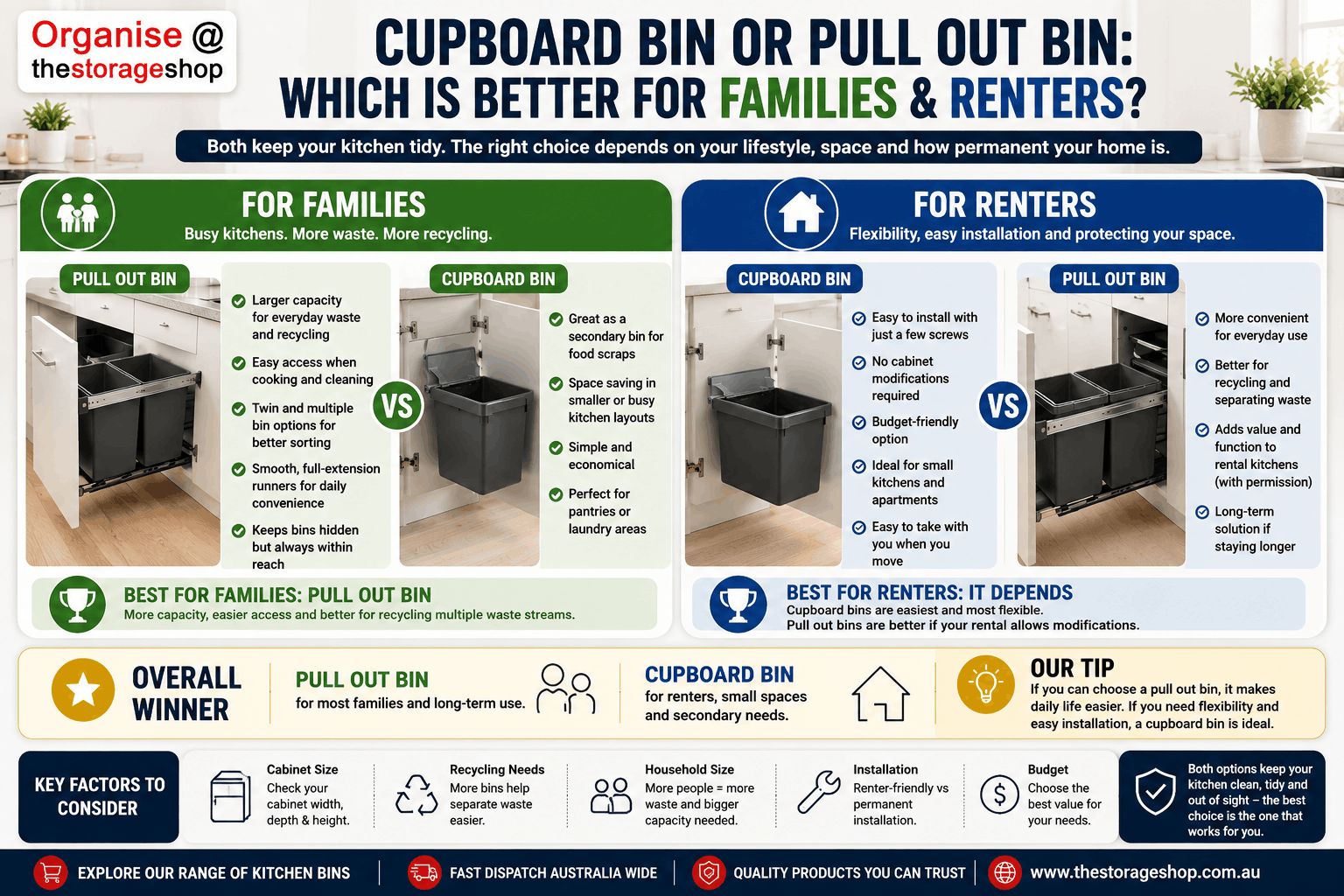
For families, a pull out bin is the stronger choice.
Family kitchens generate more rubbish, more packaging and more recycling, and a small 5L–12L cupboard bin fills too quickly during busy mornings, school-lunch prep or dinner clean-up. A pull out bin with a larger bucket or twin 2×35L compartments handles daily waste far more comfortably, and the full-extension action makes it easy for children and everyone else to use. If your family recycles regularly, a double pull out keeps sorting simple without scattering bins around the kitchen.
Cupboard Bin or Pull Out Bin: Which Is Better for Renters?
For renters, it depends on whether you can make changes to the cabinet.
If you’d rather not drill or mount runners, a freestanding bin or a simple door-mounted cupboard bin is the easier path, since some attach with minimal fixing. If you own the home or have permission for minor cabinet changes, a pull out bin is a worthwhile upgrade that makes the kitchen feel more organised and daily use more comfortable. Either way, always check the installation requirements before buying any cabinet-mounted bin.
Complete Your Kitchen Organisation
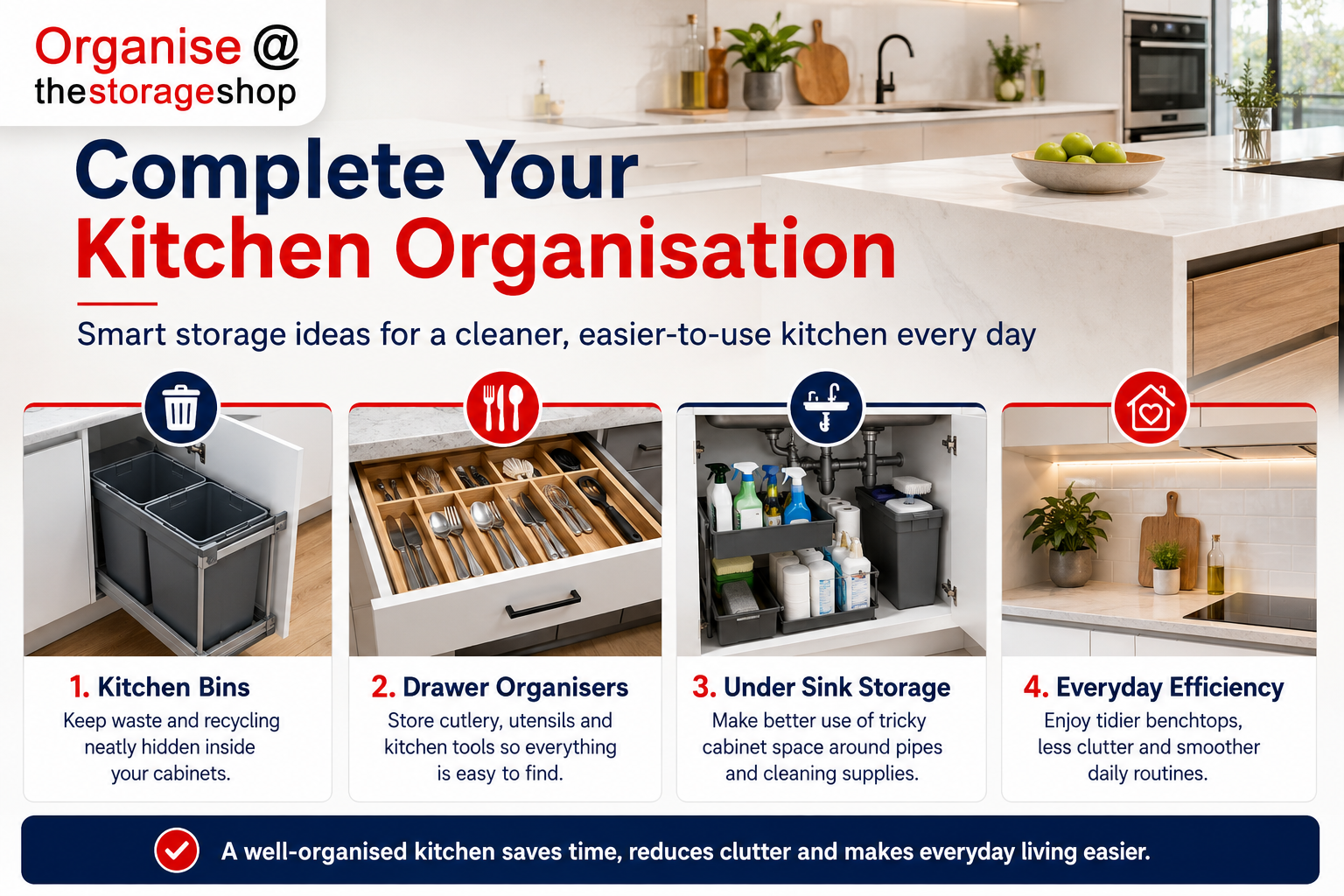
Choosing the right bin instantly makes a kitchen feel cleaner. But once waste is hidden away, the next area that usually needs attention is the drawers.
When cutlery, utensils, knives, peelers and tongs are all mixed together, everyday tasks slow down. Drawer organisers give each item a place, making cooking and cleaning more efficient. After sorting your cupboard or pull out bin, it’s worth tidying the drawers either side — our complete guide to drawer organisers, cutlery trays and inserts in Australia has practical ideas for exactly that.
A well-organised kitchen isn’t only about hiding rubbish — it’s about making every part of the space easier to use.
Shop Kitchen Bins at The Storage Online Shop
Ready to hide kitchen waste and make your space easier to use? Explore the full range of kitchen bins at The Storage Online Shop, including pull out bins, cupboard bins, under sink bins, door mounted bins, pedal bins, freestanding bins, replacement buckets and door operated bins.
Our kitchen bins range includes options for standard Australian cabinet widths such as 300mm, 400mm, 450mm and 600mm, with practical solutions for everyday waste, recycling, under-sink spaces and compact kitchens. Free shipping is available on eligible orders over $200 to most Australian states. Please check the current shipping details at checkout.
FAQs About Cupboard Bins vs Pull Out Bins
Are cupboard bins and pull out bins the same?
Not exactly. A cupboard bin is any bin that sits or mounts inside a cabinet, hidden behind the door. A pull out bin is a specific type that’s fixed to the cabinet on runner rails and slides fully out for easier access. In other words, all pull out bins are cabinet bins, but not all cupboard bins pull out.
Is a pull out bin better than a cupboard bin?
For everyday kitchen use, usually yes — a pull out bin offers full-extension access and more capacity, with singles up to 35L and doubles up to 2×35L. A cupboard bin is better for compact spaces, light waste or simple hidden storage, and typically holds 5L–12L. The right pick depends on your cabinet width and how often you cook.
Can I fit a pull out bin in a 300mm cabinet?
Yes, but only a slim single unit of around 12L–15L. For more capacity or a twin recycling system, you’ll want a 400–600mm cabinet. Always measure the internal cabinet width rather than the door, since the two are often several centimetres apart.
What is the best bin for recycling?
A double pull out bin is the best option for recycling because it gives you two separate buckets — typically 2×15L up to 2×35L — inside one cabinet. That makes it easy to sort general waste from recyclables, and keeps both hidden in a single location.
Can I put a pull out bin under the sink?
Yes, with careful measuring. Under sink cabinets contain plumbing and the sink bowl, which reduce the available height and depth. A slim pull out works if there’s clear depth in front of the pipework; otherwise a compact cupboard bin may fit better. Measure the clearance around the plumbing before ordering.
Which kitchen bin is easiest to clean?
A pull out bin with removable buckets is the easiest to clean, since the bucket lifts out to change liners, empty waste and wipe down spills. Stainless steel models resist odours and stains best.
What bin should I choose for a family kitchen?
For most family kitchens, a pull out bin is the better option because it handles frequent use and larger volumes — look at a single around 35L, or a 2×35L double if you want to separate rubbish and recycling in one cabinet.
What bin should I choose for a small apartment kitchen?
Choose either a compact cupboard bin (5L–12L) or a slim pull out bin (around 12L–15L in a 300mm cabinet), depending on your space. If the cabinet is very narrow or shallow, a door-mounted cupboard bin is usually the more suitable fit.
Final Verdict: Which One Is Right for Your Kitchen?
The right choice comes down to how you use your kitchen.
A cupboard bin is best for a simple, compact, hidden solution for light waste, food scraps or small spaces — practical and discreet when cabinet space is limited, generally in the 5L–12L range.
A pull out bin is best when you want easier full-extension access, more capacity (up to 35L single or 2×35L double), recycling separation and a more modern setup — ideal for busy households, family kitchens and anyone who wants waste storage to feel smooth and organised.
If you have a base cabinet 400mm or wider and use your bin every day, a pull out bin is usually the better long-term choice. If space is tight or you only need a small hidden bin, a cupboard bin is an excellent solution — and in many kitchens, the tidiest setup is one of each. Either way, measure your cabinet first: that single internal-width figure decides what’s actually possible.
About the author: The Storage Online Shop team helps Australian homeowners and renovators choose practical cabinet storage solutions, including kitchen bins, pull out systems and drawer organisers. Our advice is based on decades of experience helping customers find products that fit real kitchen cabinets.