
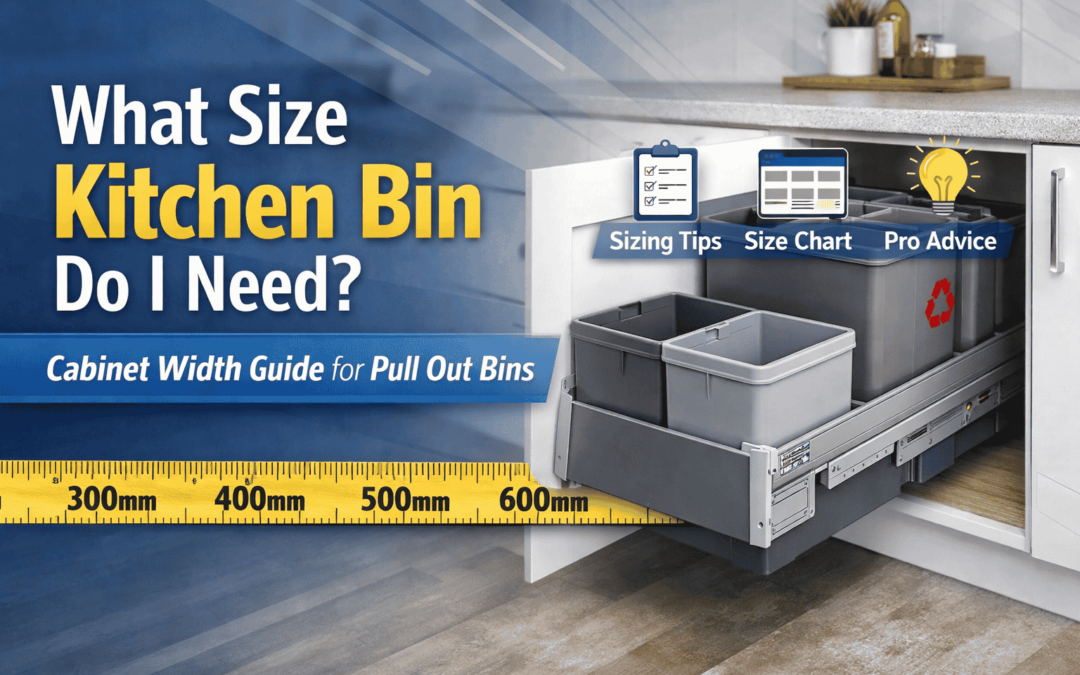
Most Australian kitchen cabinets are 300mm to 600mm wide — and choosing the wrong pull out bins for that space is the most common and costly mistake homeowners make.
Whether you are installing a pull out rubbish bin under the sink, replacing an old pull out cupboard bin, or fitting out a brand new kitchen, getting the dimensions right before you buy saves time, money, and a second trip to the hardware store.
This guide covers every cabinet width, every bin type, and every measurement you need — with a sizing table, capacity planner, and a pre-purchase checklist built for Australian kitchens.
Quick Answer: Most Australian kitchens use 300mm, 400mm, or 450mm wide cabinets. A 300mm cabinet fits a 15–32L pull out bin, a 400mm cabinet suits a 32–54L bin, and a 450mm cabinet accommodates up to 60L. Always measure your internal cabinet width, height (minimum 500mm), and depth (minimum 480mm) before purchasing.
Why Getting the Size Right Matters
Buying a pull out rubbish bin that does not fit your cabinet is one of the most common — and frustrating — mistakes Australian homeowners make. Too narrow and the frame wobbles. Too wide and the door will not close. Too tall and the runners scrape the shelf above.
Getting the correct pull out bin size means smoother daily operation, a cleaner kitchen, and a bin system that lasts for years. This guide gives you the exact measurements, a cabinet width comparison table, and a pre-purchase checklist so you buy right the first time.
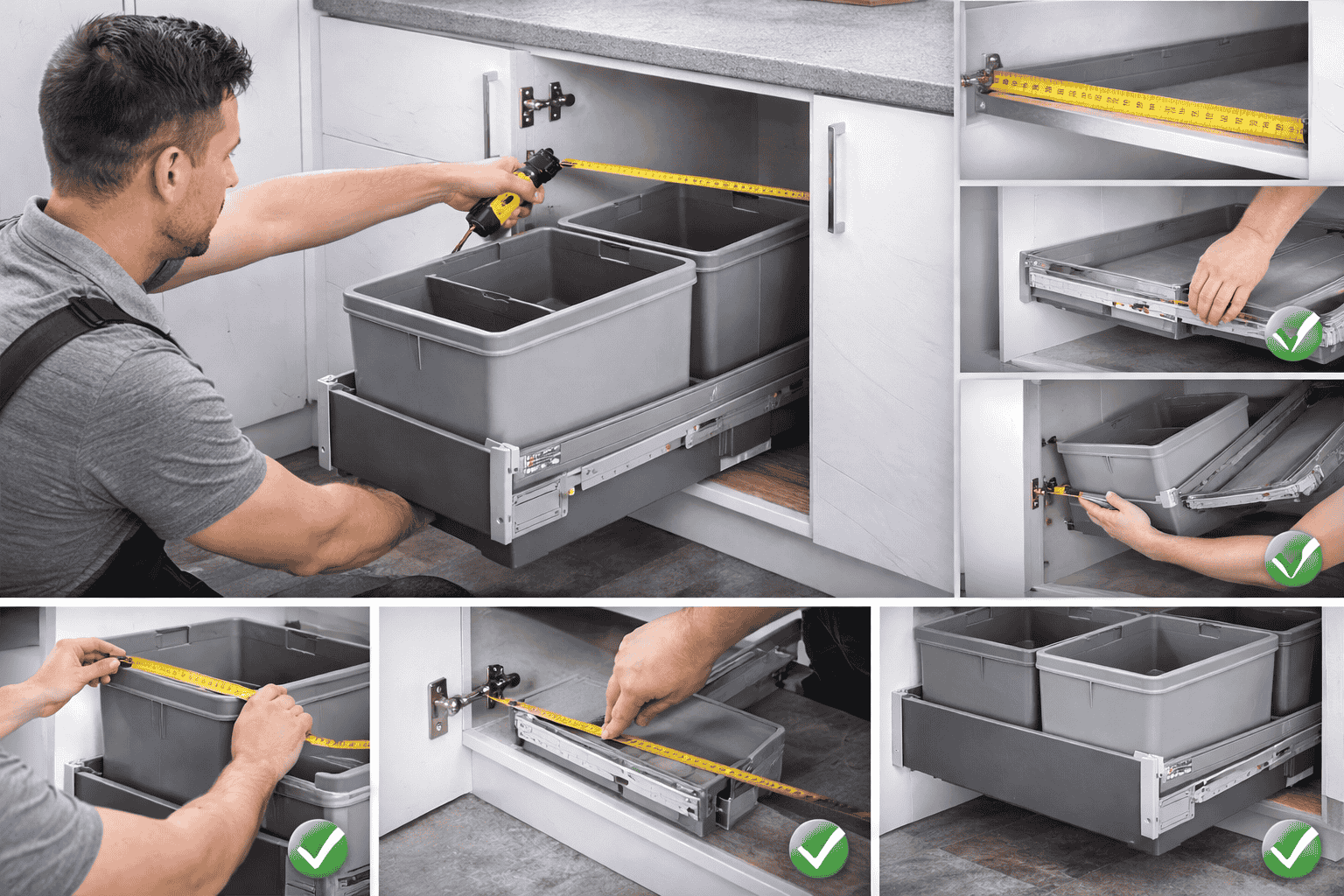
The 3 Measurements You Must Take Before You Buy
Before choosing any pull out kitchen bin, measure inside your cabinet:
| Measurement | Where to Measure | Why It Matters |
| Internal Cabinet Width | Side to side, inside the carcass walls | Determines the maximum frame width your bin system can fit |
| Internal Cabinet Height | Floor to the underside of the bench top or shelf | Must be at least 500mm for most pull out bin systems |
| Internal Cabinet Depth | Front hinge point to back wall | Most bins need 480–520mm of depth to clear the runners when open |
Pro Tip: If you have an in-frame kitchen — where a visible timber or MDF frame surrounds the door on the inside of the cabinet — subtract 30–50mm from your width measurement. The frame reduces the opening through which the bin must travel. When the door is open, if you can see a border or rebate around the inside of the opening, your kitchen is in-frame.
Pull Out Bin Size Chart — Cabinet Width Guide
Use this table to match your internal cabinet width to the right pull out bin size:
| Cabinet Width | Recommended Bin | Capacity | Best For | Compartments |
| 300mm | Single pull out bin | 15L – 32L | Small kitchens, under-sink spaces | 1 |
| 400mm | Single or double pull out bin | 32L – 54L | Average household kitchens | 1–2 |
| 450mm | Double pull out bin | 45L – 60L | Families needing recycling separation | 2 |
| 500mm | Double or triple pull out bin | 60L – 80L | Large households, island bench areas | 2–3 |
| 600mm | Triple or wide double pull out bin | 80L+ | Busy kitchens, dual waste + compost | 2–3 |
Note: These measurements refer to internal cabinet width — not the door width or cabinet exterior. Always measure inside the carcass.
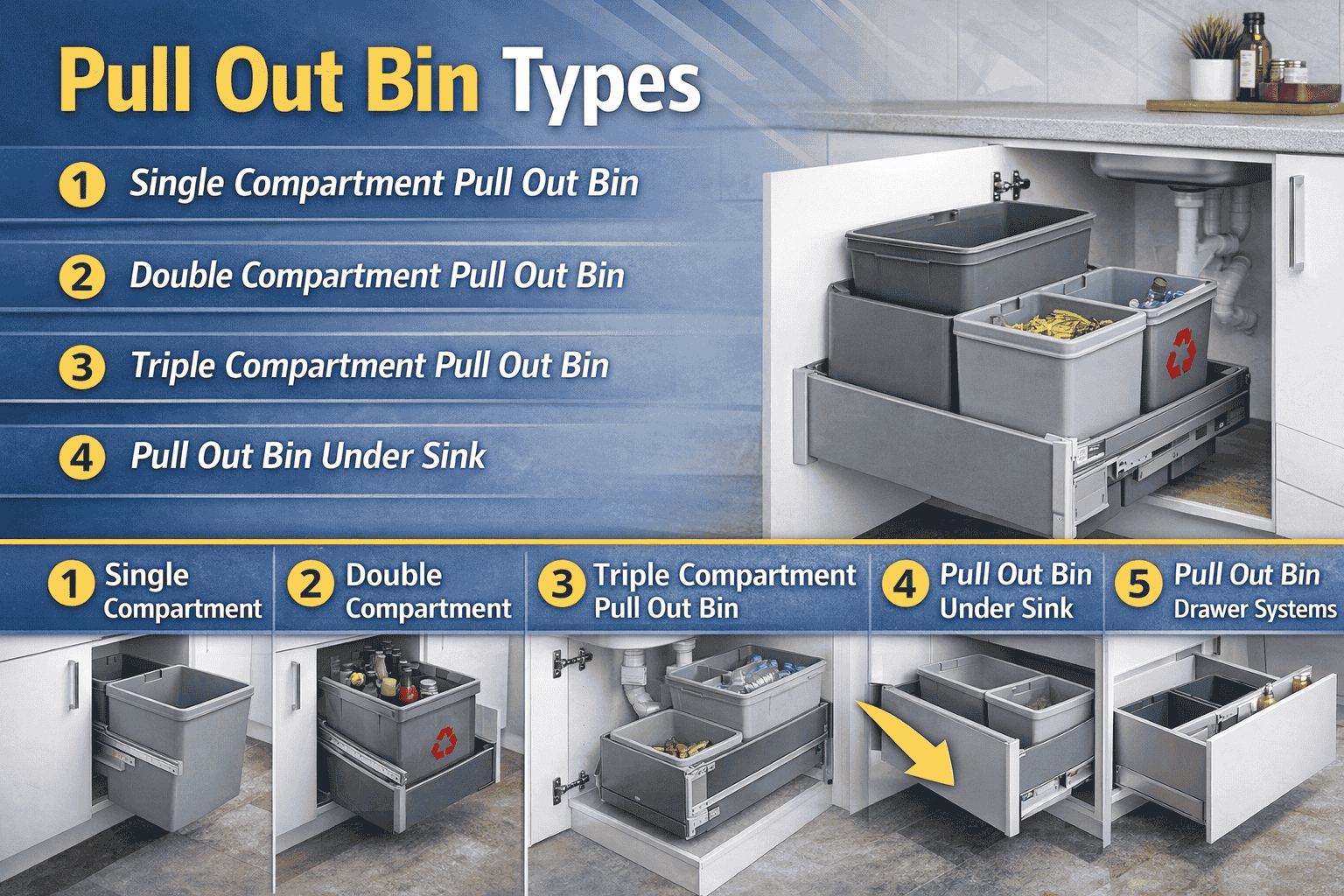
Pull Out Bin Types and Which Cabinet Size They Need
1. Single Compartment Pull Out Bin
Ideal for small kitchens or as a dedicated recycling bin. Single pull out bins typically require a minimum internal cabinet width of 300mm and deliver between 15L and 32L of capacity. Best locations: under sink, end-of-bench cabinets, bathroom vanities.
2. Double Compartment Pull Out Bin
The most popular choice for Australian households. A double pull out kitchen bin lets you separate general waste and recycling without needing two separate bins visible in your kitchen. These suit cabinets from 400mm to 500mm wide and offer combined capacity of 40L to 64L. Best locations: main kitchen base cabinet, island bench, laundry cupboard.
3. Triple Compartment Pull Out Bin
For households that compost, recycle, and manage general waste simultaneously. Triple pull out waste bins fit comfortably in 500mm to 600mm wide cabinets and offer 60L+ combined capacity. Best locations: large kitchen cabinets, renovation projects with custom cabinetry.
4. Pull Out Bin Under Sink
Under-sink pull out bins are specially designed to work around plumbing. Look for models specifically marketed as under-sink bins — they use a shallower or offset frame to avoid pipes. These are available in 300mm and 400mm widths. Key consideration: measure from the floor to the underside of your sink basin, not just to the bench top.
5. Pull Out Bin Drawer Systems
A pull out bin drawer integrates into your drawer stack rather than a hinged-door cabinet. These are frame-free and sit inside a deep drawer cavity. They require a drawer internal width of at least 280mm and a depth of 450mm or more.
What Size Pull Out Bin Under Sink?
Installing a pull out bin under sink is one of the smartest ways to use space that is otherwise wasted — but it requires more careful planning than a standard cabinet installation.
Pipes, the U-bend, and the sink basin itself all reduce the usable height, width, and depth available. Here is what to look for:
| Spec | Recommended |
| Internal cabinet width | 300mm – 400mm |
| Height (floor to sink underside) | Minimum 500mm |
| Usable depth (around pipes) | Minimum 440mm |
| Bin capacity | 10L – 30L |
| Frame type | Offset or split frame to clear U-bend |
If your pipes run through the centre of the cabinet, look specifically for a split-frame or angled-frame under-sink bin design. Standard frame bins will not clear central plumbing without modification.
Pro Tip: Always measure from the cabinet base to the underside of the sink itself — not to the bench top. The height difference is often 80–120mm and is the most common reason under-sink bins do not fit.
Capacity Planning: How Much Do You Actually Need?
Choosing the right pull out rubbish bin size is as much about how your household generates waste as it is about cabinet space. Here is a practical guide for Australian households:
- Small households (1–2 people) A compact 10L–30L single pull out bin is usually sufficient. A single person generating mostly food scraps and packaging will find a 300mm single-bin system handles daily waste without needing to be emptied more than twice a week.
- Medium households (3–4 people) A 30L–50L double-compartment pull out kitchen bin is the most practical choice. The dual setup handles general waste in one side and recycling in the other, keeping the kitchen tidy without overflow between emptying cycles.
- Large families (5+ people) A 50L–80L+ multi-bin system is ideal. Households at this scale benefit most from three compartments — general waste, recycling, and compost — which reduces how often each bin fills up and supports more sustainable waste habits without cluttering the kitchen.
Key Insight: Oversized bins waste cabinet space and make bag changes awkward. Undersized bins overflow before emptying day. Match capacity to actual usage first, then confirm the frame dimensions fit your cabinet.
Cabinet Width Pre-Purchase Checklist
Before confirming your pull out bin purchase, run through every item on this checklist:
| Check | What to Do |
| Measure internal cabinet width | Tape from inside wall to inside wall at the widest point |
| Measure internal cabinet height | Floor to underside of bench or shelf — needs 500mm minimum |
| Measure internal cabinet depth | Back wall to front edge with hinge clearance — needs 480mm minimum |
| Check for in-frame kitchen | Subtract 30–50mm from width if your doors sit inside a timber frame |
| Check hinge clearance | Open the door and check internal hinge protrusions — bins must clear these when pulling out |
| Check under-sink clearance | If installing under a sink, measure around pipes and the U-bend for usable space |
| Confirm number of compartments | Decide: single (general waste only), double (waste + recycling), triple (+ compost) |
| Confirm bin type | Door-mounted bins open with the door automatically; frame bins pull out separately — confirm which suits your cabinet |
| Allow for full runner extension | Full-extension runners need the bin to travel its full length forward — check no shelves or objects block the path |
Common Pull Out Bin Sizing Mistakes (And How to Avoid Them)
- Measuring the door width instead of the internal carcass width. The door is always wider than the opening inside. Measure the interior, not the exterior.
- Ignoring the depth requirement. Many buyers focus entirely on width and forget depth. If your pull out waste bin cannot extend fully, the lid scrapes the door and the mechanism wears out quickly.
- Forgetting in-frame kitchen deductions. If your kitchen has a traditional framed design, the timber surround reduces the usable opening by 30–50mm. This is one of the most common reasons pull out cupboard bins do not fit after purchase.
- Choosing capacity without checking frame dimensions. A 60L bin sounds perfect until you find it has a 480mm wide frame and your cabinet is only 450mm. Always verify the frame width against your internal cabinet measurement before adding to cart.
Installation Tips for Pull Out Bins
To ensure your pull out bin works smoothly and lasts longer:
- Measure your cabinet twice before installation
- Ensure there is enough depth for full runner extension
- Keep at least 10–20mm clearance for smooth movement
- Secure the frame firmly to avoid wobbling
- Test the sliding mechanism before final fixing
Tip: A properly installed pull out bin drawer improves durability and everyday usability.
How to Choose the Right Pull Out Bin for Your Kitchen
Once you have your three measurements, the decision becomes straightforward. Match cabinet width to bin size using the chart above, then apply these three filters:
- Start with your cabinet width — this sets your hard limit on frame size and narrows your options immediately.
- Then consider your household size — use the capacity planning guide above to confirm the litre volume suits how much waste your household generates between emptying cycles.
- Finally, decide on waste separation — if you recycle or compost, a double or triple compartment system is worth the extra cabinet width. Single-compartment bins are best suited to households that manage recycling externally or have a second bin elsewhere in the kitchen.
Expert Tip: Always match bin size to your cabinet first, then adjust capacity based on usage. Buying a bin because of its capacity and hoping it fits the cabinet is how sizing mistakes happen.
Why Choose The Storage Online Shop?
The Storage Online Shop has been supplying Australian homeowners, kitchen designers, and renovators with quality storage solutions for years. Here is why thousands of Australians choose us for their pull out kitchen bins:
Australian-focused range — every bin sized for standard Australian cabinets (300mm to 600mm)
- Trusted brands — Wesco (made in Germany), Kosara, and Kimberley
- Free shipping over $200 — to SA, NSW, VIC, ACT, and parts of QLD
- Expert advice — call (08) 8296 0955 or email info@thestorageonlineshop.com.au before you buy
- 30-day returns — unused, original-packaged items accepted within 30 days of delivery
Pull Out Bin Size Frequently Asked Questions
1. What size pull out bin do I need?
For most Australian kitchens, a 30L–54L double-compartment pull out bin suits a household of two to four people and fits cabinets 400mm to 450mm wide. For 300mm cabinets, choose a 15L–32L single bin. For 500mm+ cabinets with heavy waste output, go for a 60L+ double or triple system.
2. What cabinet width is needed for a pull out bin?
Pull out bins are available for cabinets from 300mm to 600mm wide. The most common Australian kitchen cabinet is 400mm to 450mm, which suits single and double bin systems. Always measure the internal carcass width — not the door — before selecting a bin.
3. Can I install a pull out bin under sink?
Yes, provided you have minimum 500mm height from the floor to the underside of the sink basin, 440mm usable depth around the plumbing, and a cabinet width of 300mm to 400mm. Always choose a bin specifically designed for under-sink use with an offset or split frame to clear the U-bend.
4. What is the best pull out rubbish bin for small kitchens?
A single-compartment pull out cupboard bin in a 300mm to 400mm cabinet, with 15L to 32L capacity and full-extension runners. Under-sink installation maximises remaining floor and bench space further.
5. Are pull out kitchen bins worth it?
Yes. They keep waste hidden behind cabinet doors, reduce odours, improve hygiene, and eliminate the need for a freestanding bin taking up floor space. For households with children or pets, the concealed design is a practical bonus.
6. What is the standard cabinet size for a pull out bin in Australia?
The most common Australian kitchen cabinet width is 400mm to 450mm. These sizes suit double-compartment pull out bins with a total capacity of 45L to 64L — ideal for a household of two to four people managing both general waste and recycling.
7. What is the difference between a pull out bin and a door-mounted bin?
A pull out bin sits on runners fixed to the cabinet base — you open the door, then pull the bin out separately. A door-mounted bin attaches to the door itself, so the bins come out automatically when you open the door. Both are available in 300mm to 600mm widths.
8. How much capacity do I actually need?
A single person or couple needs 15–32L. A family of three to four needs 45–64L with two compartments. Households that compost should look at 60L+ triple-compartment systems.
Shop Pull Out Bins at The Storage Online Shop
The Storage Online Shop offers a wide range of pull out kitchen bins designed to suit standard Australian cabinetry — from compact 15L single-bin systems for 300mm cabinets to large 80L+ triple-compartment solutions for full kitchen renovations. Each product includes detailed dimensions and installation guidance, making it easier to choose the right fit for your cabinet.
We offer free shipping on orders over $200 across most Australian states, including South Australia, New South Wales, Victoria, ACT, and parts of Queensland.
Not sure which style suits your kitchen? Explore our guide on kitchen bin trends and pull out bin ideas to compare modern designs and find the best solution for your space.