
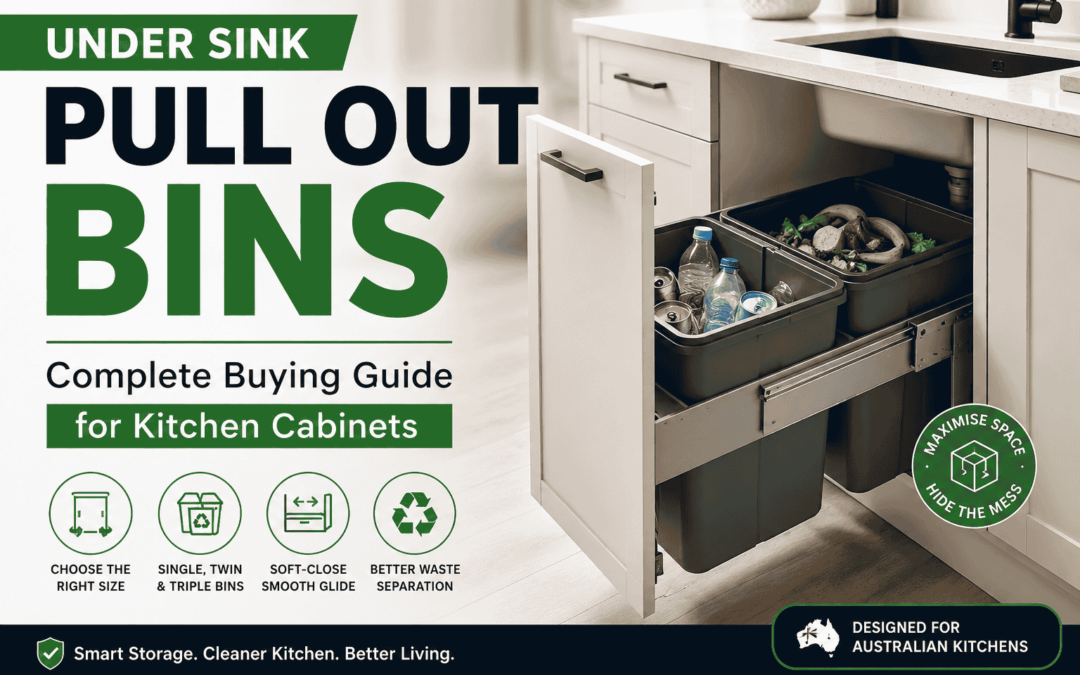
Modern Australian kitchens are designed to be clean, functional, and space-efficient — and one of the most overlooked upgrades is the kitchen bin system. Traditional freestanding rubbish bins take up valuable floor space, create visual clutter, and make day-to-day waste management less hygienic.
That’s why more Australian homeowners are choosing under sink pull out bins — also known as pull out rubbish bins —for modern kitchen cabinets. These concealed waste systems slide neatly inside cabinetry, keeping rubbish hidden while improving kitchen organisation and convenience.
Whether you’re renovating your kitchen, upgrading cabinet storage, or simply looking for a smarter waste solution, this guide explains everything you need to know about choosing the right pull out kitchen bin for your home.
Quick Answer
An under sink pull out bin (also called a pull out rubbish bin) is a concealed waste system installed inside a kitchen cabinet, usually beneath the sink. These systems slide out on runners, keeping rubbish hidden while improving kitchen organisation and recycling separation.
To choose the right pull out kitchen bin:
– Match the bin to your cabinet width (300mm, 400mm, 450mm, or 600mm)
– Measure around plumbing and sink traps
– Choose capacity based on household size
– Prioritise full-extension soft-close runners
– Select single, twin, or triple-bin configurations based on recycling needs
Wesco and Kimberley are among the most trusted pull out bin brands in Australia, while Blum-compatible systems are popular in premium kitchen renovations.
What is an under sink pull out bin?
An under sink pull out bin is a sliding waste bin system installed inside a kitchen cabinet, mounted on metal runners that allow it to extend forward when accessed and slide back inside the cabinet when not in use. Unlike freestanding bins, the rubbish remains completely hidden behind a cabinet door.
Most systems include:
- Single, twin, or triple bin compartments
- Full-extension ball-bearing runners (with optional soft-close)
- A floor-mounted or side-mounted frame
- Removable inner buckets for easy emptying and cleaning
- An optional door bracket so the bin pulls out when the cabinet door opens
These concealed kitchen bins are most commonly installed in under-sink cabinets, but they also work well in pantry cabinets, island benches, and utility cupboards.
How does an under sink pull out bin work?
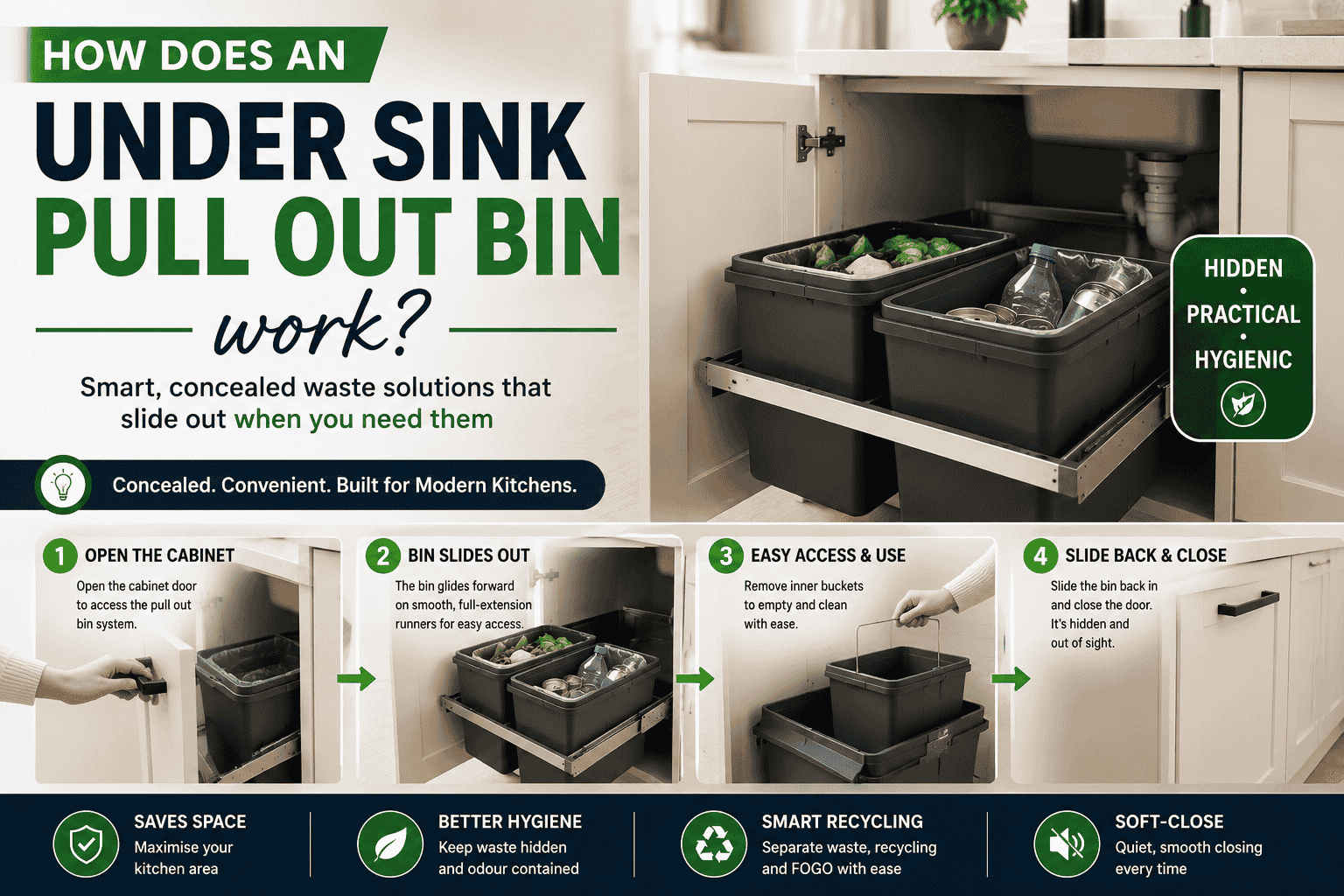
An pull out bin under sink works by sliding on a pair of metal runners attached to a frame fixed to the base of the cabinet. When you open the cabinet door, the bin glides forward on the runners — either manually, or automatically if a door bracket is fitted. Quality systems use full-extension ball-bearing slides, which let the bin pull out completely so you can access the entire opening without leaning over.
When closed, the bin sits flush inside the cabinet, with the buckets concealed behind the door. Soft-close models use hydraulic dampers (similar to those in Blum BLUMOTION drawers) to slow the closing action and prevent slamming.
Why install an under sink pull out bin?
Built-in pull out bins improve four things at once: floor space, kitchen aesthetics, hygiene, and recycling separation. Because the rubbish is enclosed inside cabinetry, it’s protected from pets, insects, and odours, and you reclaim the floor space a freestanding bin would occupy.
Australian homeowners typically choose pull out bins because they:
- Free up floor space in compact kitchens and apartments
- Create the streamlined look of a modern, handleless or shaker kitchen
- Reduce kitchen odours by keeping rubbish enclosed
- Make it easier to separate general waste, recycling, and FOGO
- Improve workflow during cooking and cleaning
- Add resale value during a kitchen renovation
Across Australia, kitchen design trends increasingly favour integrated waste systems and concealed kitchen storage. Apartment developments, compact home layouts, and modern open-plan kitchens have accelerated demand for hidden kitchen bins that improve both aesthetics and functionality. At the same time, FOGO rollout across multiple Australian councils is encouraging more households to install double and triple-bin systems for easier waste separation.
What types of pull out kitchen bins are available?
There are four main types of pull out kitchen bins available in Australia, each suited to different cabinet sizes and household needs. For a broader look at all kitchen waste management systems, including concealed rubbish storage, built-in recycling bins, and slide out waste units, read our detailed guides on 2026 kitchen rubbish bins guide.
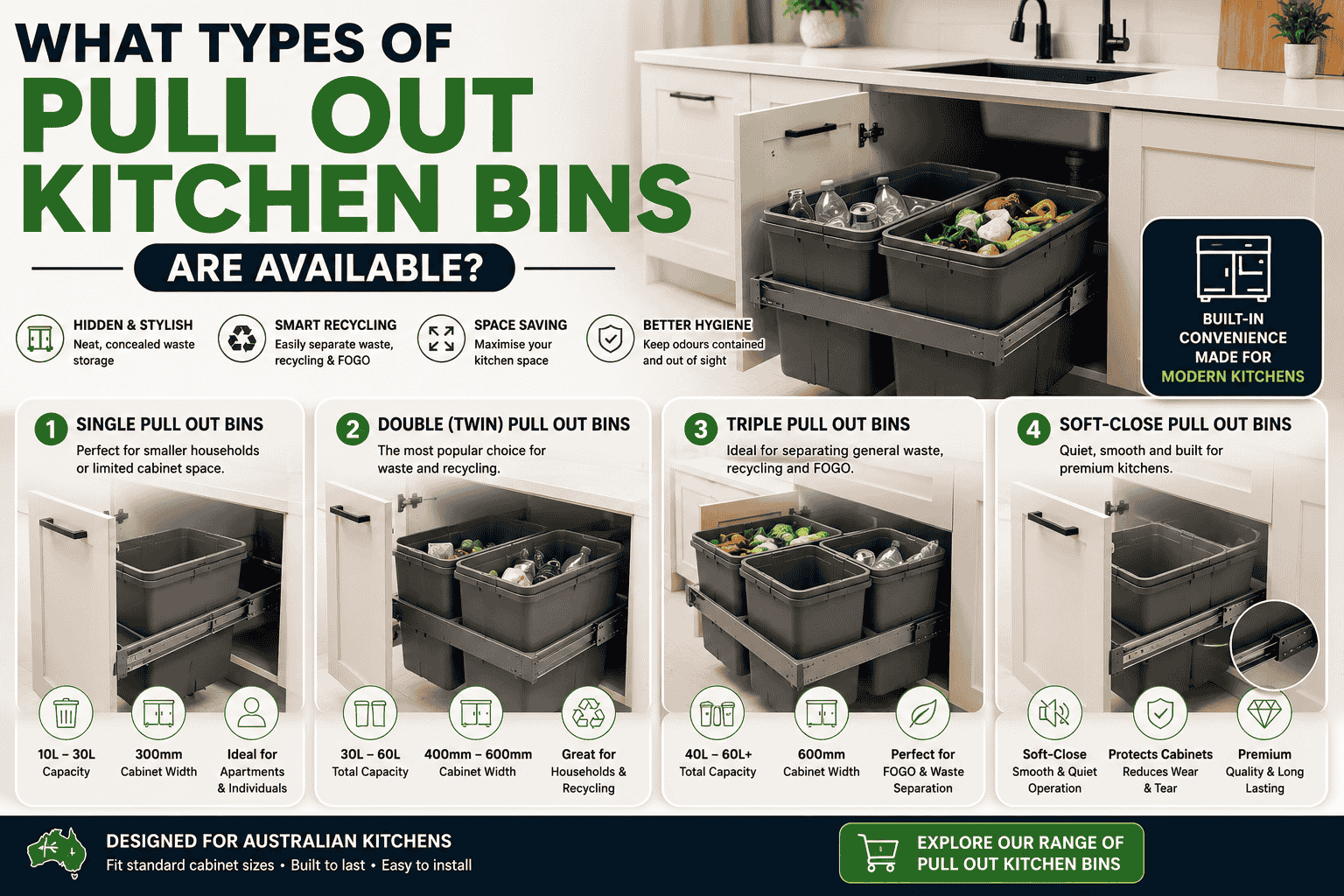
- Single pull out bins
Single pull out bins contain one waste compartment and are the most compact option. They typically range from 10L to 30L and suit cabinets as narrow as 300mm. Best for apartments, studio kitchens, and households with low waste volumes. The trade-off is no built-in recycling separation.
- Double (twin) pull out bins
Twin-bin systems are the most popular choice in Australian kitchens because they handle waste and recycling in one unit. Common configurations include 2 x 15L (30L total), 2 x 20L (40L total), and 2 x 30L (60L total). Most twin systems require 400mm–600mm cabinets.
- Triple pull out bins
Triple-bin systems include three compartments — typically two 10L bins and one 20L bin — making them ideal for households separating general waste, recycling, and food organics (FOGO), which is increasingly required by councils across NSW, VIC, and SA. Triple systems usually need a 600mm cabinet.
- Soft-close pull out bins
A soft-close pull out bin uses hydraulic runner systems that automatically slow the closing action, preventing slamming and reducing long-term wear on cabinetry and hardware. Soft-close mechanisms create quieter operation and are commonly used in premium modern kitchen renovations.
Bottom-mount vs side-mount vs door-mount: which is right?
The mounting style determines how the bin attaches to your cabinet and how it operates.
| Mount type | How it works | Best for |
| Bottom-mount | Frame screws to the cabinet floor; bin pulls out manually or via door bracket | Most under-sink installations |
| Side-mount | Runners attach to cabinet sides | Cabinets with floor obstructions or deep base profiles |
| Door-mount | Bin attaches directly to the cabinet door and slides out automatically when door opens | The most popular AU configuration; best for one-handed access |
Door-mount is the most common choice for Australian under-sink installations because it offers true one-step access — open the door, the bin comes out with it.
What cabinet width do I need for an under sink pull out bin?
Australian kitchen cabinets are built to standard widths, and pull out bins are sized to match. The cabinet width is the single most important measurement when choosing a bin.
| Cabinet width | Recommended bin type | Typical capacity | Best for |
| 300mm | Single bin or slim twin | 15L–30L | Small kitchens, apartments |
| 400mm | Compact twin bin | 30L–40L | Couples, small families |
| 450mm | Standard twin bin | 40L–60L | Average Australian families |
| 600mm | Large twin or triple bin | 60L–90L | Large families, entertainers |
Always measure the internal cabinet width — not the external dimension or door width. For a complete walkthrough of pull out bin measurements, cabinet depth requirements, and under sink sizing considerations, read our detailed minimum space required for a pull out bin guide.
What capacity should I choose for my household?
Match capacity to household size and waste-generation habits.
- 1–2 people: 15L–20L single bin
- 3–4 people: 30L–40L twin bin
- 5+ people / entertainers: 40L–68L twin or triple bin
If your household generates a lot of recycling — especially glass and cardboard — size up. The recycling compartment fills faster than the general waste side in most homes.
Which Pull Out Bin Should You Choose?
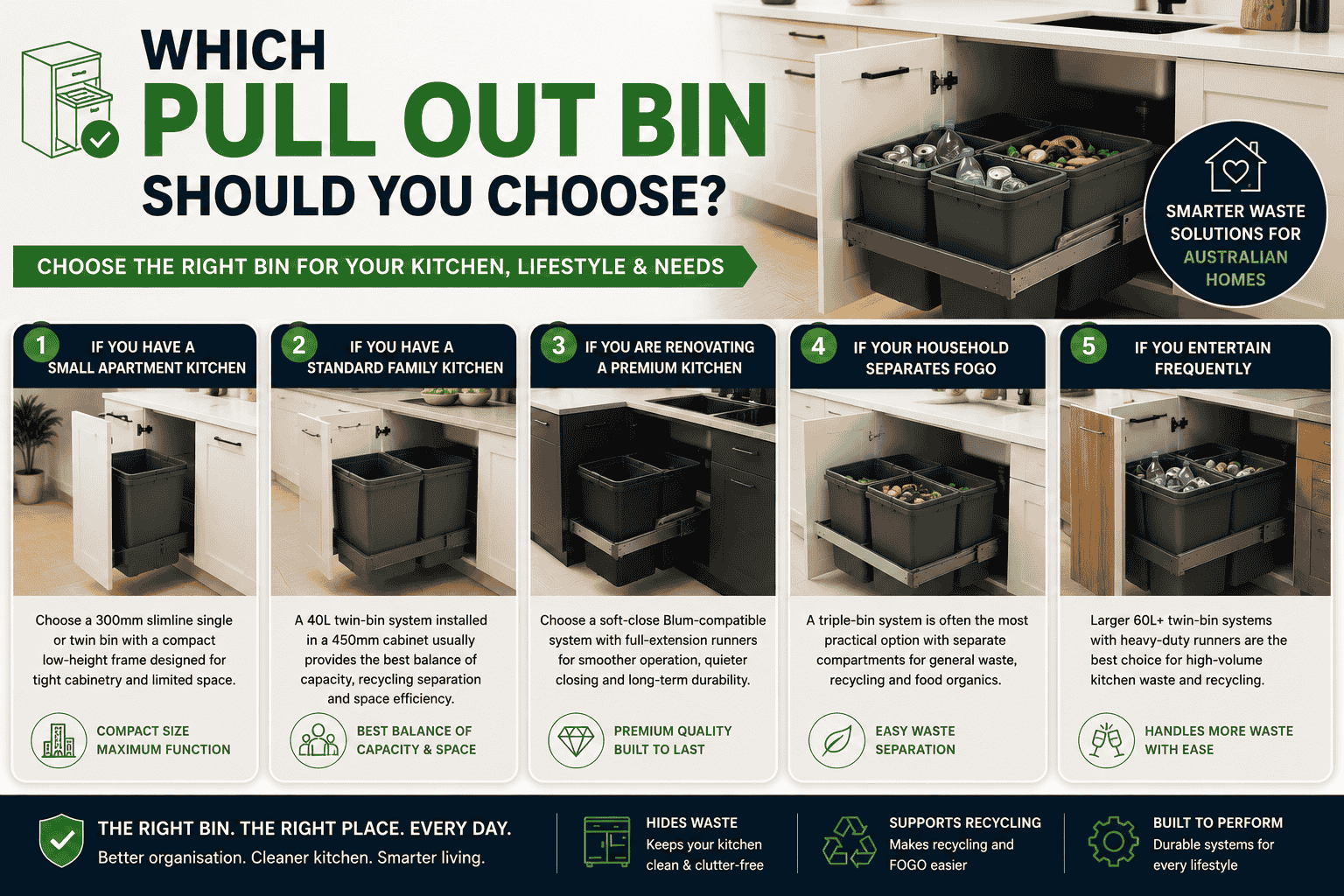
Choosing the right pull out kitchen bin depends on your cabinet size, kitchen layout, household size, and recycling needs.
- If you have a small apartment kitchen
Choose a 300mm slimline single or twin bin with a compact low-height frame designed for tight cabinetry and limited floor space.
- If you have a standard family kitchen
A 40L twin-bin system installed inside a 450mm cabinet usually provides the best balance of waste capacity, recycling separation, and space efficiency.
- If you are renovating a premium kitchen
Choose a soft-close Blum-compatible system with full-extension runners for smoother operation, quieter closing, and long-term durability.
- If your household separates FOGO
A triple-bin system is often the most practical option because it allows separate compartments for general waste, recycling, and food organics.
- If you entertain frequently
Larger 60L+ twin-bin systems with heavy-duty runners are usually the best choice for high-volume kitchen waste and recycling.
| Situation | Recommended Bin |
| Small apartment | 15L–20L single bin |
| Couple | 30L twin bin |
| Family kitchen | 40L–60L twin bin |
| FOGO separation | Triple-bin system |
| Luxury renovation | Soft-close Blum-compatible |
| Heavy recycling | Large twin bin |
| Compact under-sink cabinet | Low-height shorty model |
| High-use kitchen | Heavy-duty runner system |
Will a pull out bin fit around my sink plumbing?
Yes, but the available space depends on your sink’s drain pipe configuration. Under-sink cabinets typically contain an S-trap or P-trap, plus connections for a dishwasher hose, water filter, or instant hot water unit. These plumbing elements reduce the usable height inside the cabinet.
To work around plumbing:
- Choose a shorty or low-height model (designed specifically for under-sink fitment)
- Use a door-mount system, which keeps the frame lower and out of the way of pipes
- Measure the height clearance from the cabinet floor to the lowest point of any pipe before ordering
- Allow at least 50mm of clearance above the bin lid for easy lifting
If plumbing eats too much space, an alternative is to install the pull out bin in a neighbouring cabinet (often the dishwasher-side cupboard) rather than directly under the sink.
Common mistakes to avoid when buying a pull out bin
- Measuring the cabinet’s external dimension instead of the internal opening
- Ignoring plumbing that protrudes into the cabinet space
- Choosing too small a capacity and ending up emptying the bin daily
- Skipping recycling separation and regretting it within months
- Buying low-quality runners that wobble or stick after 6–12 months of use
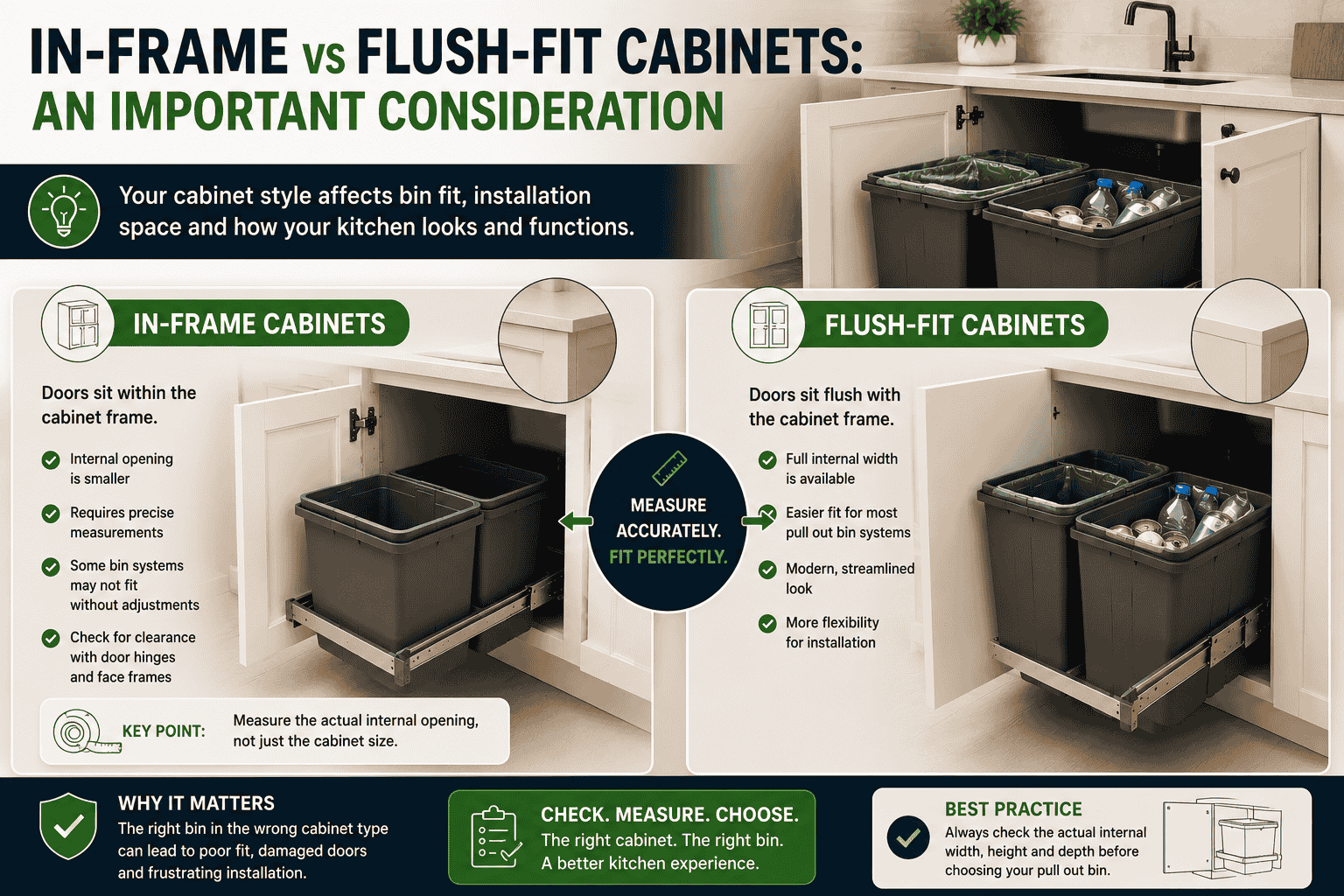
- Forgetting to check in-frame vs flush-fit cabinet construction
What Australian Renovators Often Overlook
Many Australian homeowners focus heavily on cabinet width when choosing a pull out bin, but experienced renovators know that runner clearance, plumbing depth, and cabinet opening width are often more important than the nominal cabinet size itself.
In older homes and Hamptons-style kitchens with in-frame cabinetry, the internal opening can be significantly narrower than expected. This regularly causes standard 400mm systems to catch on face frames or hinges during installation.
Another commonly overlooked factor is future recycling requirements. Households that initially install single-bin systems often upgrade to double or triple-bin configurations later once FOGO or expanded recycling becomes part of their council waste program.
Planning for future waste separation early during a kitchen renovation usually results in a far more practical long-term setup.
In-frame vs flush-fit cabinets: an important consideration
This is the issue most buying guides skip — and it’s where Australian buyers get caught out.
- In-frame cabinets have a face frame around the door opening, which reduces the usable aperture by 10–25mm on each side. So a 400mm in-frame cabinet may only have a 370mm usable opening — too narrow for a 400mm-rated bin to pull through.
- Flush-fit (frameless) cabinets — used in most modern Australian kitchens — have no inner frame, so the cabinet’s external width matches the usable opening.
Before ordering, open your cabinet door and measure the actual opening — not the cabinet’s nominal size. If you have an in-frame cabinet, you may need to size down or choose a slim-profile bin.
What features should I look for in a quality pull out bin?
Six features separate a long-lasting bin from one that fails within a year:
- Full-extension ball-bearing runners — let the bin pull out completely; basic roller runners only extend partway
- Soft-close mechanism — protects cabinetry, eliminates slamming, lasts longer
- Hi-impact plastic or stainless steel buckets — easier to clean and resistant to cracking
- Removable buckets — essential for proper cleaning and bag changes
- Weight rating of 25kg+ — important when the recycling side is full of glass bottles
- Lid type — fixed, hinged, or open; door-mount bins typically don’t need lids because the cabinet door provides the seal
Expert Tip: If your household regularly recycles glass bottles, avoid lightweight roller-runner systems. Glass is significantly heavier than general waste, and cheaper runners often fail early under recycling loads. Full-extension ball-bearing runners with a 25kg+ weight rating are generally the best long-term option for family kitchens.
Best brands of under sink pull out bins in Australia
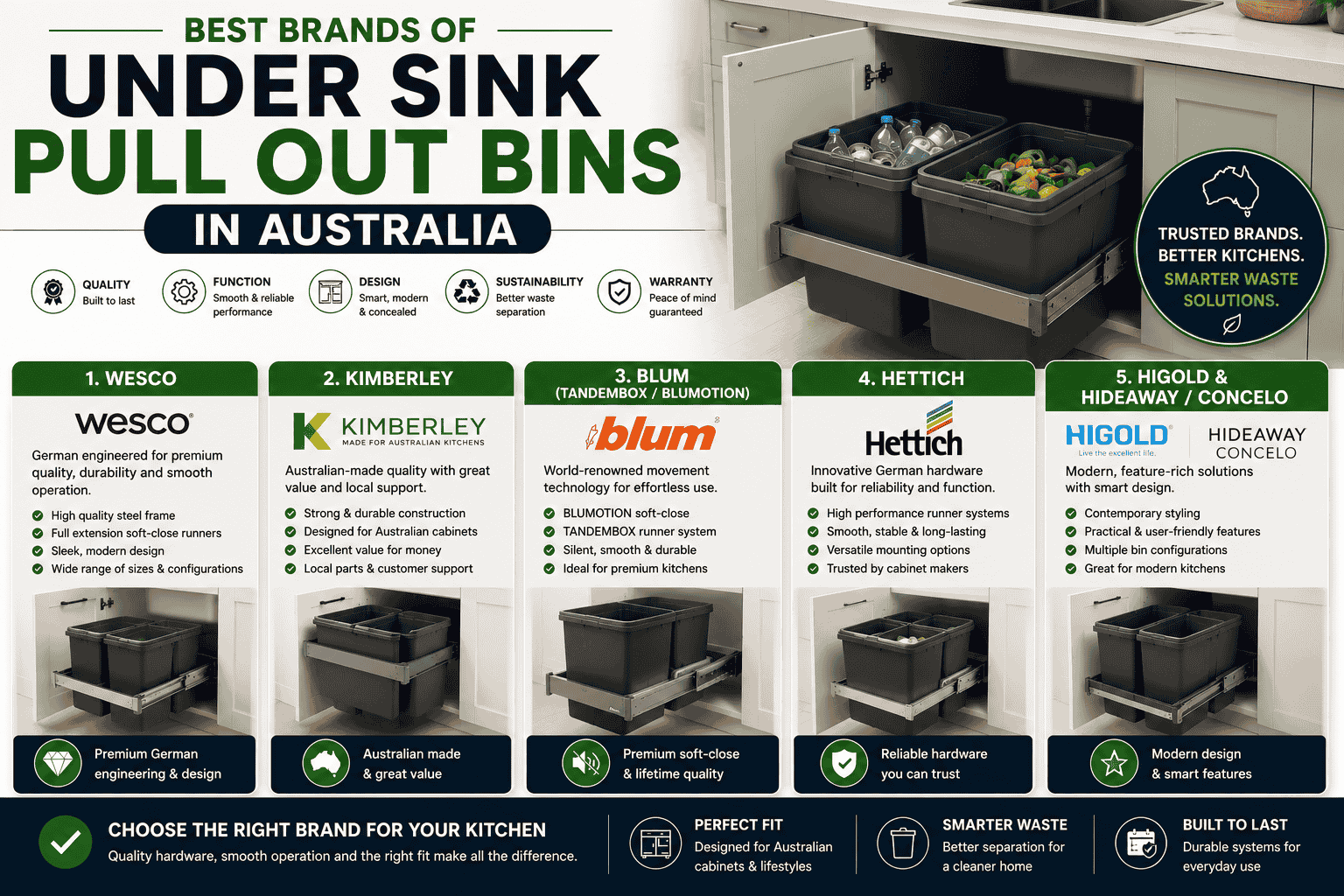
A handful of brands dominate the Australian market for kitchen pull out rubbish bins. Each offers a different balance of price, build quality, and design integration.
-
Wesco
Made in Germany, Wesco is widely considered one of the best pull out bin brands in the world. Their range covers shorty (low-height) models for tight under-sink cabinets, twin bins for everyday use, and triple bins for households doing FOGO separation. All Wesco systems use full-extension ball-bearing runners and removable hi-impact plastic buckets. The Wesco Pull Boy Z is also designed to integrate with Blum TANDEMBOX antaro drawer systems for premium kitchen installations.
-
Kimberley
Kimberley is the leading Australian-made pull out bin brand. Built from sturdy hi-impact plastic with crack-resistant refrigerator-grade lids, Kimberley bins are designed specifically for Australian cabinet dimensions. A standout feature is the ability to stack two bins in one cabinet — creating four slide-out compartments — which is unusual at this price point.
-
Blum (TANDEMBOX / BLUMOTION)
Blum is the gold-standard for runner systems globally. While Blum doesn’t manufacture bins themselves, many premium pull out bins (including Wesco’s Pull Boy Z) are designed to work with Blum TANDEMBOX drawer systems and BLUMOTION soft-close hardware. If your kitchen renovation already uses Blum drawers, choose a bin engineered for Blum compatibility.
-
Hettich
Hettich is another German hardware specialist offering high-quality runners and pull out frames. Their systems are common in mid-to-upper range Australian kitchen renovations.
-
Higold and Hideaway / Concelo
Higold offers value-oriented pull out bins with integrated door brackets, while New Zealand-designed Hideaway and its premium Concelo range focus on innovative features like Active Lid technology, which removes the need to lift a lid manually.
| Brand | Best For |
| Wesco | Premium German-engineered systems |
| Kimberley | Australian-made value |
| Blum-compatible | Luxury renovations |
| Hettich | Premium runner systems |
| Hideaway / Concelo | Modern feature-rich kitchens |
Top under sink pull out bins from The Storage Online Shop
Looking for the right integrated waste system for your kitchen? Browse our complete collection of pull out kitchen bins, including soft-close, twin-bin, and under sink waste solutions designed for Australian cabinetry. These four models cover the most common Australian cabinet sizes and use cases.
- Wesco 30L Pullout Bin – Shorty (W31) A low-height twin bin (2 x 15L) designed specifically for under-sink cabinets where plumbing limits clearance. Full-extension ball-bearing slides, removable plastic buckets with steel rod handles, made in Germany. Best for shallow under-sink fitments.
- Wesco 40L Door Mount Twin Bin (W40D) The most popular all-rounder. Two 20L compartments, door-mounted so the bin pulls out automatically when the cabinet door opens. Suits 400–450mm cabinets. Ideal for the average Australian family kitchen separating waste and recycling.
- Wesco 40L Triple Pull Out Bin (W40T) Two 10L compartments plus one 20L compartment for households doing waste, recycling, and FOGO separation. Hinged door and door-mount configurations available. Best for renovators planning a long-term, three-stream waste setup.
- Kimberley 30L Twin Bin (KR06) Australian-made twin bin (2 x 15L) with the unique ability to stack two units in a single cabinet for four-compartment separation. Refrigerator-grade plastic lid resists cracking. Best value Australian-made option.
Browse our full range of pull out kitchen bins to compare all available models.
How do I install an under sink pull out bin?
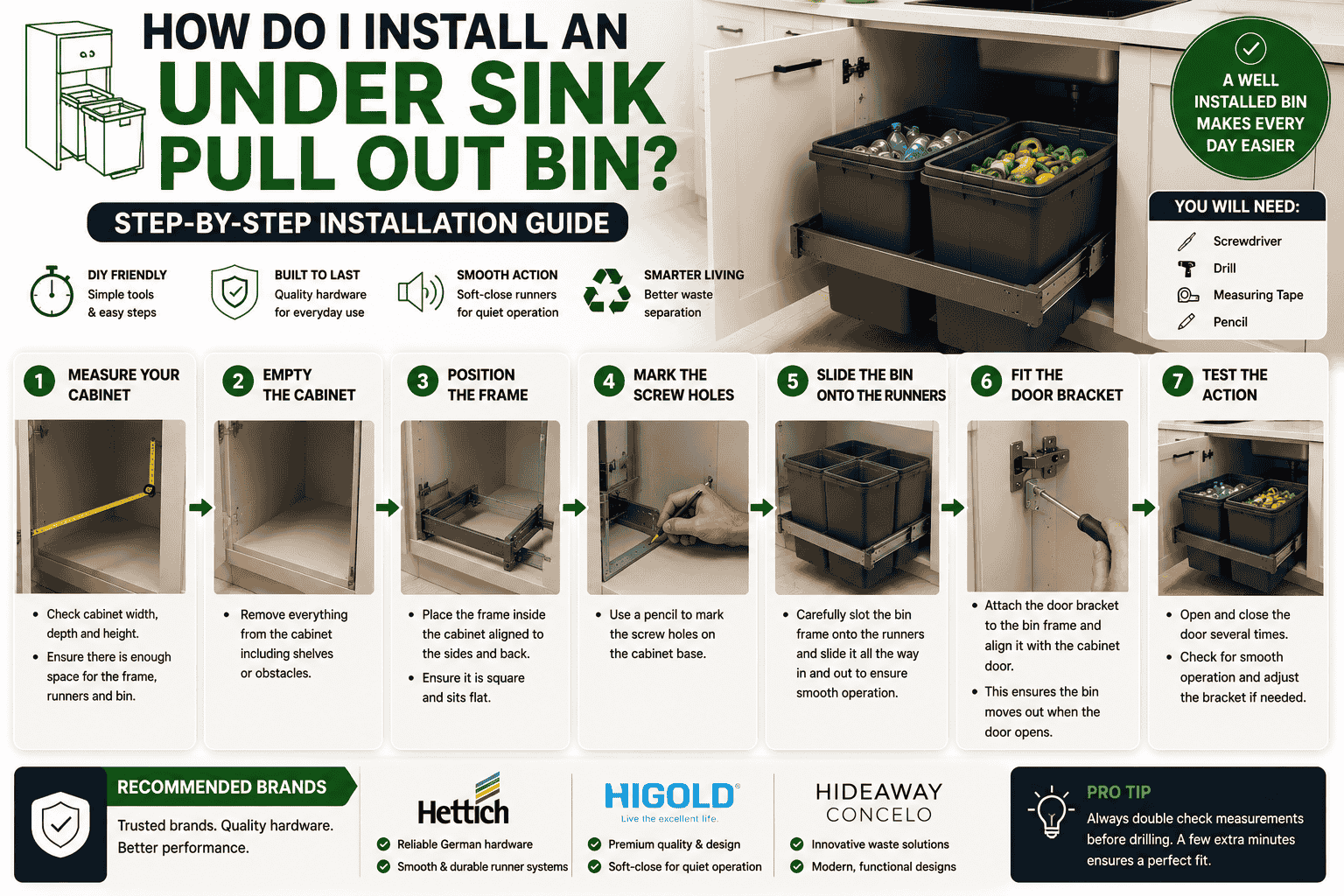
Most pull out bins are DIY-friendly and take 30–45 minutes to install with basic tools.
- Measure your cabinet — internal width, depth, and height clearance
- Empty the cabinet and remove anything blocking the floor
- Position the frame at the back of the cabinet, square to the side walls
- Mark the screw holes, drill pilot holes, and screw the frame to the cabinet base
- Slide the bin onto the runners and test full extension
- Fit the door bracket (if door-mounted) by aligning it with the cabinet door
- Test the action — open and close several times to confirm smooth operation
Call a cabinetmaker or installer if you have custom cabinetry, complex plumbing, or in-frame cupboards that need modification.
Expert Tip:
If you’re renovating a kitchen from scratch, plan the pull out bin location early in the cabinet layout process. This helps avoid plumbing conflicts and allows you to position the waste system closer to food preparation zones for better kitchen workflow.
Many Australian homeowners now position pull out bins beside the sink or dishwasher rather than directly underneath the sink, especially in larger kitchens where additional cabinet space is available.
How do I clean and maintain a pull out bin?
Regular cleaning keeps the bin hygienic and the runners working smoothly.
- Empty buckets weekly and rinse with warm soapy water
- Wipe the frame and runners monthly with a damp cloth and mild disinfectant
- Lubricate runners every 6 months with a silicone-based spray (avoid WD-40, which attracts dust)
- Replace bin liners as soon as they’re full to prevent leakage
- Check for cracks in plastic buckets annually, especially around handles and rims
Removable buckets make deep cleaning much easier — lift them out, wash thoroughly, and dry before refitting.
How much does an under sink pull out bin cost in Australia?
Pull out bins fall into three price bands:
- Budget ($80–$150): Single 10–20L bins, basic runners, often without soft-close. Suitable for renters, light use, or temporary fitouts.
- Mid-range ($150–$300): Twin bin systems, full-extension runners, removable buckets. Includes most Wesco and Kimberley models. Best value-for-money for the average family kitchen.
- Premium ($300+): Triple bins, soft-close, Blum-compatible systems, larger capacities (60L+). Ideal for full kitchen renovations and high-use households.
Investing slightly more upfront in soft-close ball-bearing runners typically pays back over 5+ years, since cheap runners are the first component to fail.
Pull out bin vs freestanding bin — which is better?
| Feature | Pull Out Bin | Freestanding Bin |
| Hidden storage | Yes | No |
| Floor space saving | Excellent | Poor |
| Modern appearance | Excellent | Moderate |
| Recycling separation | Built-in twin/triple options | Requires multiple bins |
| Hygiene | Enclosed, pet/pest resistant | Open or lidded |
| Kitchen organisation | Integrated | Standalone |
| Upfront cost | Higher | Lower |
| Long-term value | Adds resale appeal | Replaceable |
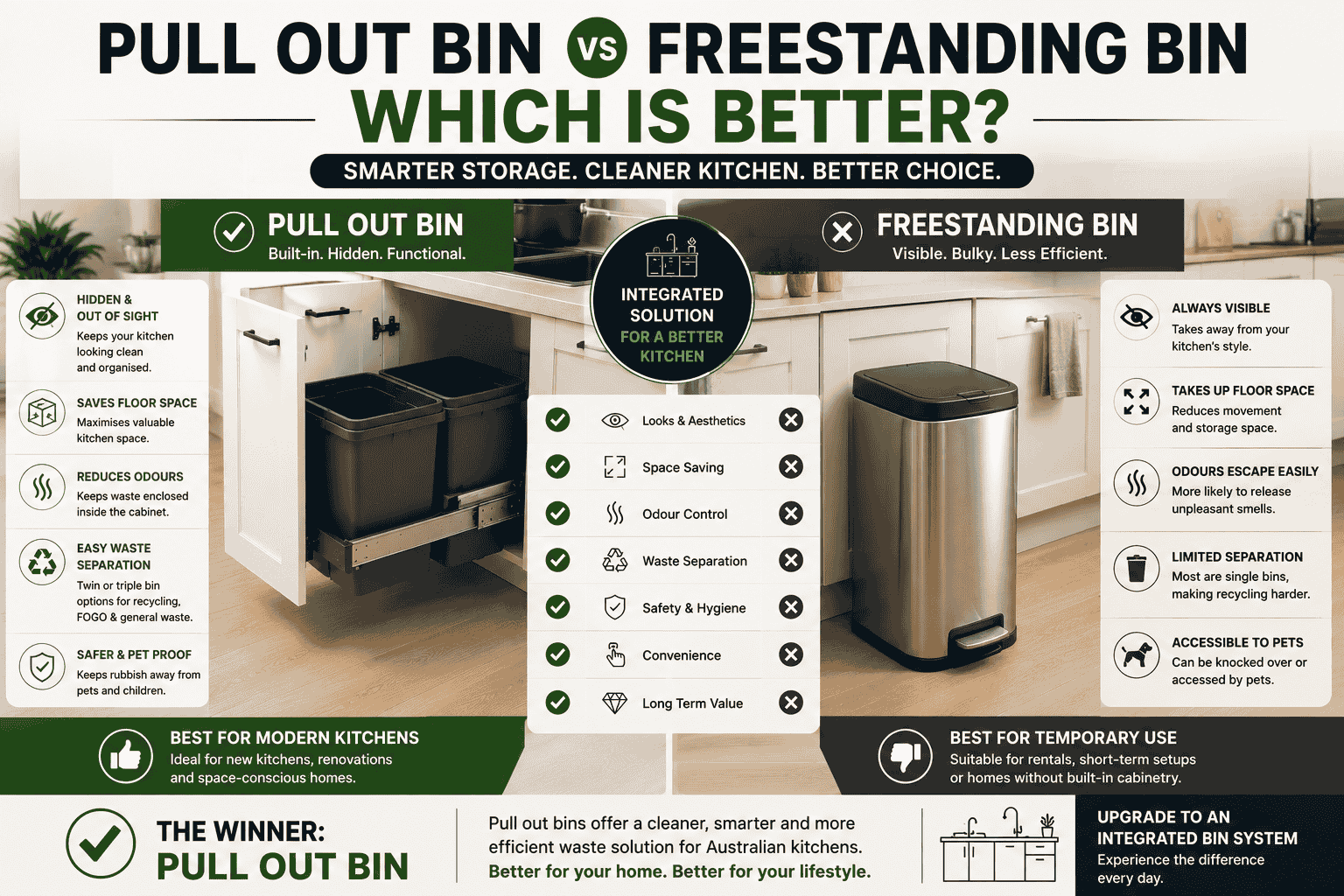
For a deeper format-by-format comparison, see our complete guide on pull out vs under sink vs cupboard bins.
Where to buy under sink pull out bins in Australia
The best place to buy under sink pull out bins in Australia is from a specialist kitchen storage retailer that stocks proven brands, offers cabinet-size matching, and ships nationwide. General hardware stores carry limited ranges; cabinetmakers can supply premium European systems but typically only as part of a full kitchen build.
The Storage Online Shop stocks the complete Wesco and Kimberley ranges plus Blum-compatible TANDEMBOX systems, with delivery to South Australia, New South Wales, Victoria, the ACT, and most of Queensland. Free shipping applies to orders over $200 across these states. Tasmania, the Northern Territory, Western Australia, and parts of QLD are serviced with calculated freight.
Why choose The Storage Online Shop for your kitchen pull out bin?
We’ve been supplying kitchen storage solutions to Australian homeowners, renovators, and trades for over a decade, and we focus exclusively on storage — not general hardware.
- Specialist range, not a general catalogue. We stock the complete Wesco range (made in Germany), Kimberley (Australian-made), and Blum-compatible TANDEMBOX systems. Every product is selected for fit, durability, and compatibility with standard Australian cabinetry — so you’re not sifting through low-quality imports.
- Cabinet-size expertise. Australian kitchens use 300mm, 400mm, 450mm, and 600mm standard cabinets, but in-frame and custom cabinetry add complications. Our team can recommend the right model based on your actual measurements — including plumbing clearance and door-style.
- Free shipping over $200 across most of Australia. SA, NSW, VIC, ACT, and most of QLD qualify for free shipping on orders over $200. We ship Australia-wide, with calculated freight to remote areas.
- 30-day returns. Returns accepted within 30 days of delivery in original, unused condition.
- Real Australian support. Phone and email support based in Australia — speak to someone who actually knows the products, not a generic call centre. Contact us on (08) 8296 0955 or info@thestorageonlineshop.com.au.
- Trusted by renovators and trades. Cabinetmakers, builders, and kitchen designers across Australia use us as their go-to source for pull out bin systems on renovation projects.
What is the best under sink pull out bin for Australian kitchens?
For most Australian households, a 30L–40L twin-bin system installed in a 400mm or 450mm cabinet offers the best balance of capacity, recycling separation, and space efficiency. Homes with larger families or FOGO requirements may benefit from 60L+ twin or triple-bin systems.
Are pull out bins better than normal kitchen bins?
Pull out kitchen bins are generally considered better than freestanding bins because they save floor space, improve kitchen appearance, simplify recycling, and create more hygienic concealed waste storage inside cabinetry.
Frequently Asked Questions
-
What size cabinet is needed for a pull out bin?
Most pull out kitchen bins are built to standard Australian cabinet widths of 300mm, 400mm, 450mm, or 600mm. A 300mm cabinet typically fits a single 15L–20L bin, while 450mm and 600mm cabinets accommodate twin or triple bin systems with combined capacities of 40L–90L. Always measure the internal cabinet width — not the door — and check plumbing clearance before ordering.
-
Can under sink pull out bins work with plumbing?
Yes, but the available installation space depends on pipe positioning. Under-sink cabinets contain S-traps, P-traps, and dishwasher hose connections that reduce usable height. Choose a shorty or low-height model designed for under-sink fitment, or use a door-mount system that keeps the frame lower. Always measure clearance from the cabinet floor to the lowest pipe before purchasing.
-
Are pull out kitchen bins easy to install?
Most pull out kitchen bins are DIY-friendly and take 30–45 minutes to install with a drill, screwdriver, and tape measure. The frame screws to the cabinet base, the bin slides onto the runners, and an optional door bracket connects to the cabinet door. Professional installation may help with custom cabinetry, in-frame cupboards, or complex plumbing layouts.
-
Are double pull out kitchen bins worth it?
Yes — double bins are the most popular configuration in Australian kitchens because they make recycling and waste separation effortless. Most homes need at least two streams (general waste plus recycling), and twin systems handle this in a single cabinet. Households running FOGO collection should consider a triple-bin system instead, which adds a dedicated food organics compartment.
-
Which pull out kitchen bin is best for small kitchens?
For small kitchens and apartments, a slim 300mm single or twin bin (15L–30L total capacity) is ideal. Look for low-height shorty models if your cabinet has plumbing eating into vertical space. Door-mounted systems are particularly useful in compact kitchens because they offer one-handed access without taking up additional clearance.
-
How long do pull out bin runners last?
Quality full-extension ball-bearing runners — like those used by Wesco, Blum, and Hettich — typically last 10+ years with normal household use, often outlasting the cabinetry itself. Cheaper roller-style runners may wear out within 2–3 years, especially if overloaded. Stay within the manufacturer’s weight rating (usually 25–40kg) and lubricate runners every 6 months to maximise lifespan.
-
What is the most popular pull out bin size in Australia?
The most popular configurations in Australian family kitchens are 30L–40L twin bin systems installed in 400mm or 450mm cabinets. These provide enough capacity for general waste plus recycling without needing an oversized cabinet, and they fit the standard cabinet widths used in most Australian kitchen designs. Larger 60L+ systems are popular in renovated family homes and entertaining-focused kitchens.
-
Are soft-close pull out bins worth the extra cost?
Yes, for most homes. Soft-close runners use hydraulic dampers to slow the closing action, eliminating slamming and reducing wear on both the runners and the cabinetry. The premium is typically $30–$80 over basic runners, but the lifespan extension and quieter operation make it worthwhile — especially in open-plan kitchens where bin noise carries through the living area.
Final thoughts
As Australian kitchens continue moving toward integrated storage and concealed cabinetry, under sink pull out bins are becoming a standard inclusion in both renovations and new home builds.
Under sink pull out bins are one of the smartest kitchen storage upgrades available today. They reclaim floor space, simplify recycling, improve hygiene, and lift the appearance of any kitchen — from a compact apartment fitout to a full renovation.
The decision framework comes down to four steps: measure your cabinet width, check plumbing clearance, match capacity to your household, and choose quality runners. From there, brands like Wesco and Kimberley deliver dependable, well-engineered systems built for Australian kitchens.
Ready to upgrade your kitchen waste setup? Explore our complete range of kitchen bins — with free shipping on orders over $200 to most states across Australia.