
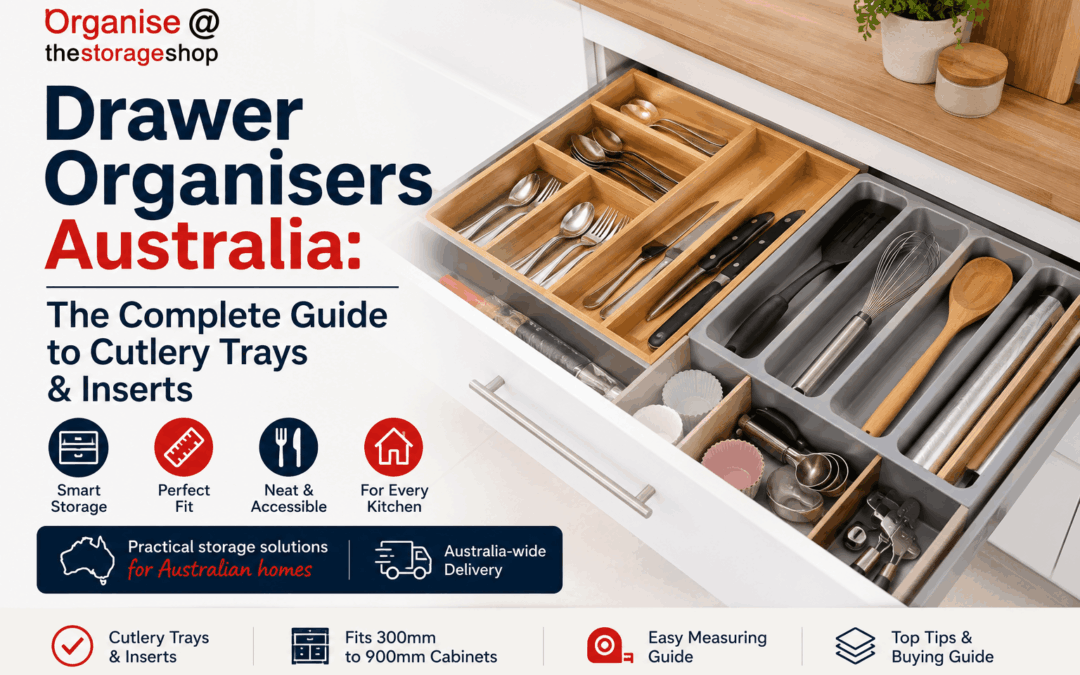
Kitchen drawers do a lot of work every day. They hold cutlery, serving spoons, cooking tools, peelers, measuring spoons, food wraps, bottle openers, small gadgets and the odd item that has nowhere else to go. When everything is mixed together, it becomes harder to cook, clean and move around the kitchen smoothly.
That is why a drawer organiser is such a simple but powerful upgrade. A well-chosen cutlery tray or drawer insert turns a messy drawer into a neat, easy-to-use storage zone. Instead of digging through a pile of utensils, you open the drawer and find what you need in seconds.
Australian kitchens range from compact apartments to large family kitchens and custom-renovated cabinetry, so choosing the right organiser comes down to size, function, material and how the drawer is used. This guide walks you through all of it — including the part most guides skip: what size tray actually fits a standard Australian cabinet.
In this guide: the difference between trays, inserts and dividers · the main types and what each suits · what size fits a 300–900mm cabinet · how to measure in seven steps · which material to choose · how to organise every drawer · the brands worth knowing · and how it all fits into a tidy kitchen.
Quick answer: what is the best drawer organiser for Australian kitchens?
The best drawer organiser for most Australian kitchens is one sized to the drawer’s internal dimensions and laid out around daily use. A compartmented cutlery tray suits everyday forks, knives and spoons, while a wider insert or adjustable organiser handles longer cooking tools like tongs, spatulas and ladles. The right one makes the drawer easier to use, not just tidier.
What are drawer organisers?
Drawer organisers are trays, inserts or dividers placed inside drawers to create separate sections for different items. They stop things sliding around, mixing together or getting buried under each other.
In the kitchen, they’re commonly used for everyday cutlery, cooking utensils, knives and serving tools, measuring spoons and baking accessories, food wrap and foil, small gadgets, and tea towels. Although they’re most associated with kitchens, the same trays and dividers also work in bathrooms, laundries, wardrobes, offices, caravans and garage drawers.
What’s the difference between a cutlery tray, drawer insert and divider?
People use these terms interchangeably, but they behave differently — and knowing which is which saves you buying the wrong thing.
| Product type | What it is | Best use |
| Cutlery tray | A one-piece tray with set compartments | Forks, knives, spoons and teaspoons |
| Drawer insert | Any fitted or removable organiser placed inside a drawer | Cutlery, utensils, tools or mixed items |
| Drawer divider | A separator (often spring-loaded) that splits the drawer into sections | Flexible, self-set layouts |
| Adjustable organiser | An organiser that expands or changes layout | Drawers between standard sizes |
| Cut-to-size insert | A tray trimmed to your exact internal width | Renovated and custom kitchens |
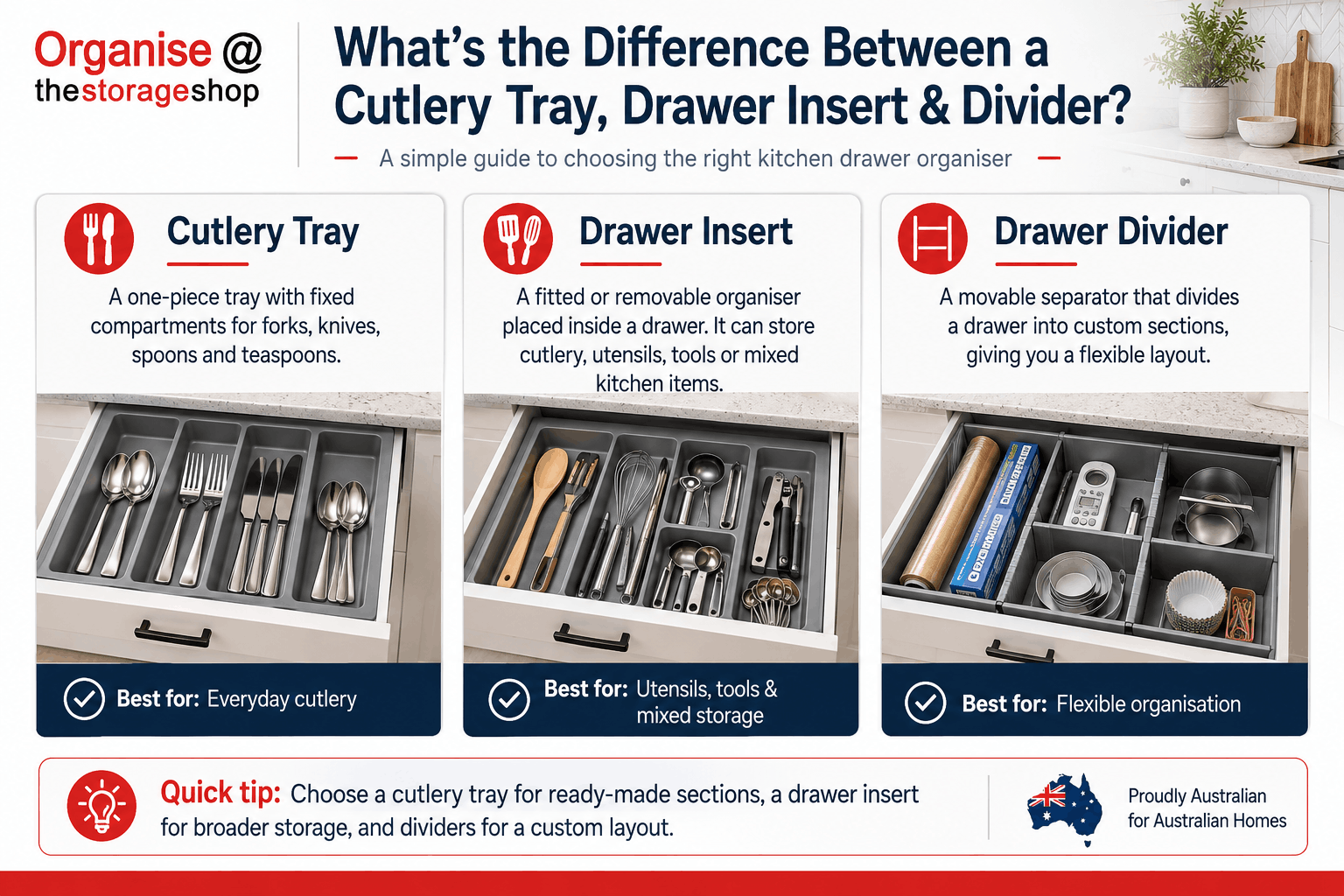
A cutlery tray gives you a ready-made layout the moment it goes in. A drawer insert is the broader fix when you want to store utensils, tools or mixed items. Dividers give you the freedom to set your own section widths, which is handy for awkward, long contents.
Why drawer organisation matters in a busy kitchen
A tidy drawer does more than look good — it changes how the kitchen works. Cooking gets easier because the tools you need are visible and within reach. Cleaning up is faster because every item has a place to return to. And you stop buying duplicates because you can see what you already own.
It matters most where bench and cabinet space are tight. Rather than spreading utensils across several drawers or leaving them on the benchtop, a good insert uses the space you have. For families it’s simpler still: kids find spoons and lunchbox items, guests locate cutlery without asking, and the whole kitchen feels more practical.
Types of drawer organisers for Australian homes
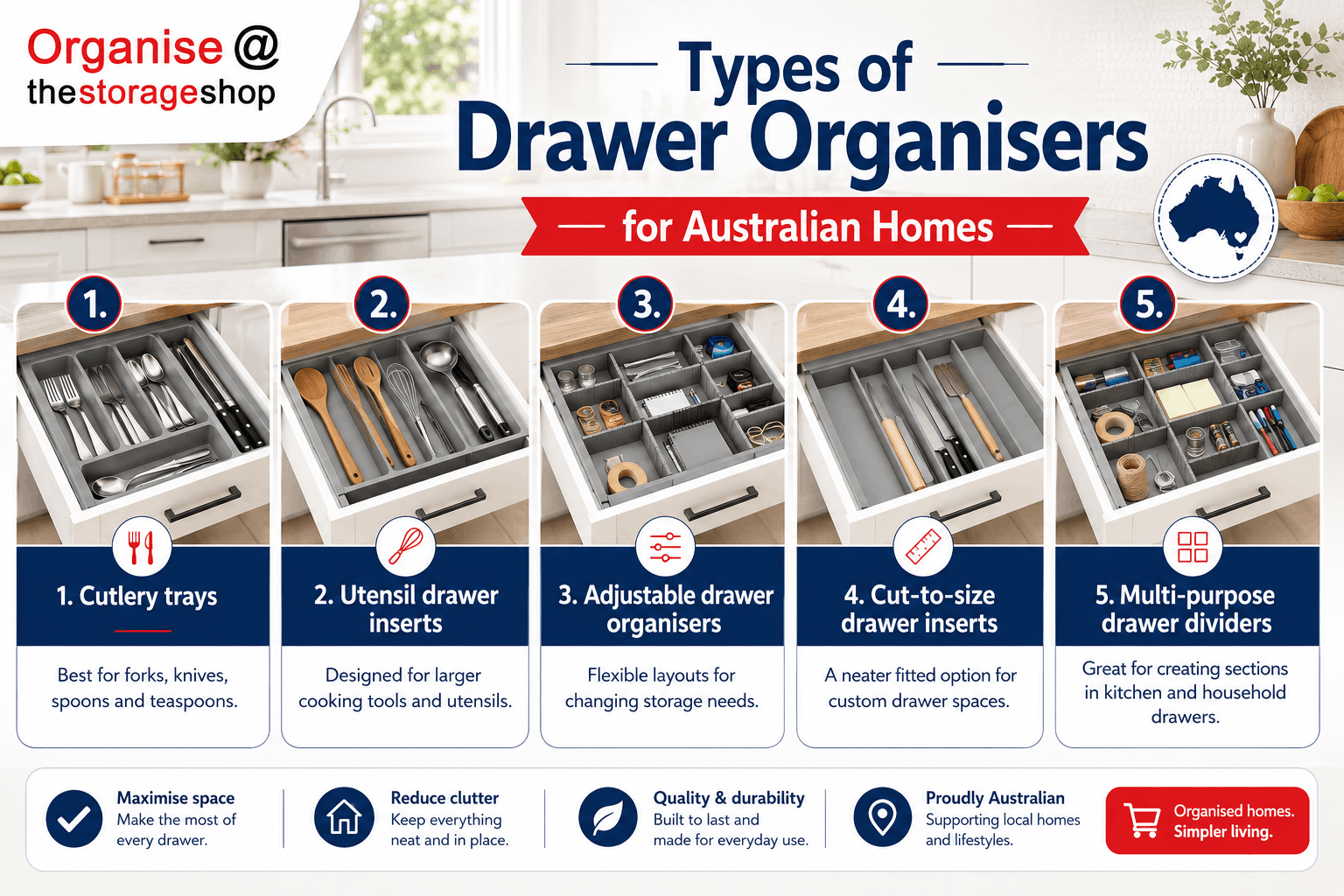
Different drawers need different solutions. Before buying, think about what the drawer needs to hold.
- Cutlery trays
The most common kitchen organiser, with separate sections for knives, forks, spoons, teaspoons and sometimes serving pieces. Ideal for everyday drawers, family dining cutlery, apartments, rentals, renovated kitchens and butler’s pantries. A good one fits neatly and still lets the drawer close.
- Utensil drawer inserts
Designed for larger cooking tools — spatulas, tongs, ladles, whisks, peelers, can openers. Because these are longer and bulkier than cutlery, they need wider compartments than a standard tray offers.
- Adjustable drawer organisers
These create sections that suit your items rather than forcing everything into fixed slots. Useful for mixed tools, small gadgets, baking accessories and homes where storage needs change.
- Cut-to-size drawer inserts
Trimmable inserts give a cleaner, fitted result — especially in custom cabinetry, renovations or drawers that don’t suit standard tray sizes. Measure carefully and check the product details before ordering.
- Multi-purpose drawer dividers
Not every drawer needs a tray. Simple dividers organise tea towels, napkins, lunchbox accessories, reusable bags or pantry packets, and they work well in bathroom vanities, wardrobes and laundry drawers too.
You can compare these formats side by side in our cutlery trays and drawer organisers range.
Best drawer organiser by kitchen need
| Kitchen need | Best organiser choice | Why it works |
| Everyday cutlery | Cutlery tray | Keeps dining items separated |
| Large utensils | Wide drawer insert | Allows longer tools to fit |
| Small kitchen | Compact organiser | Uses limited space efficiently |
| Renovated kitchen | Fitted or cut-to-size insert | Creates a cleaner finish |
| Family kitchen | Durable, easy-clean tray | Handles frequent daily use |
| Rental property | Removable organiser | Easy to install and take with you |
| Mixed gadget drawer | Adjustable organiser | Creates flexible sections |
| Butler’s pantry | Matching drawer inserts | Keeps secondary storage tidy |
What size cutlery tray fits your drawer? (Australian cabinet sizes)
Australian kitchens are built around standard kitchen cabinet dimensions in Australia — base cabinets typically come in 300mm, 400mm, 450mm, 600mm and 900mm widths — but the inside of the drawer is always narrower than the cabinet, because the drawer box, sides and runners take up space. So the cabinet width gives you the ballpark; the internal measurement tells you what actually fits.
Use the table below as a starting point, then measure before you buy. Interior widths vary between drawer systems, so treat these as a guide rather than a guarantee.
| Cabinet width | Rough internal drawer width | Tray approach that usually works |
| 300mm | ~230–260mm | One slim cutlery tray, or a 2–3 section divider |
| 400mm | ~330–360mm | A compact cutlery tray with a small utensil section |
| 450mm | ~380–410mm | A standard cutlery tray, or a tray plus a knife dock |
| 600mm | ~520–560mm | A full cutlery tray alongside a utensil tray, or a modular set |
| 900mm | ~820–860mm | Twin trays, a modular clip-together set, or a trimmable tray |
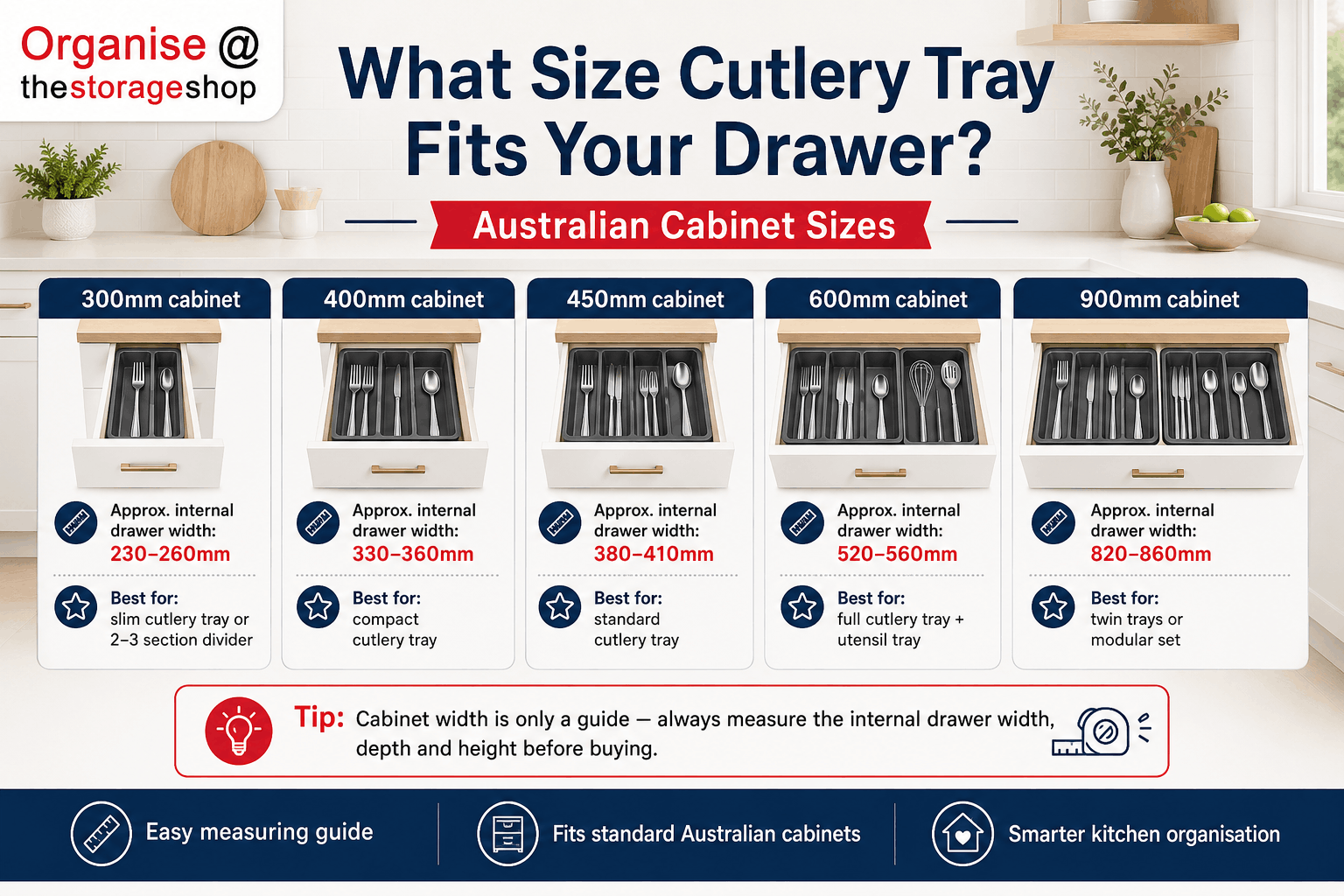
The pattern is simple: the wider the drawer, the more you can mix and match. A 600mm or 900mm drawer is roomy enough to run separate zones for eating cutlery, prep tools and serving pieces — which is where modular and trimmable options earn their place. This is also the same range of cabinet widths your base cabinets use for pull-out bins, so the two upgrades plan together neatly.
How to measure a drawer for a cutlery tray or insert
To size an organiser, measure the inside of the empty drawer — width, depth and height — and leave a few millimetres of room so the tray drops in and lifts out easily. Most returns happen because someone measured the cabinet or the drawer front instead of the usable space.
- Remove everything from the drawer.
- Measure the internal width from the left inside wall to the right inside wall, at the narrowest point.
- Measure the internal depth from the front inside wall to the back wall.
- Measure the internal height from the drawer base to the lowest point of clearance above it.
- Check for runners, side panels or fixings that intrude into the space.
- Compare your three numbers with the product dimensions.
- Choose an organiser that sits comfortably inside, with a little room to spare.
Never measure the outside of the drawer front — the internal space is what matters. For a cut-to-size tray, double-check the dimensions before ordering.
What material is best for a drawer organiser?
The best material comes down to your kitchen’s look, how hard the drawer gets used, and your budget. Plastic and stainless steel wipe clean in seconds and shrug off daily life; bamboo brings warmth but needs a gentler touch; clear trays make everything easy to spot but show wear over time.
| Material | Cleaning | Durability | Look | Best for |
| Plastic (PP) | Quick wipe or rinse; some dishwasher-safe | Good | Practical, often white or bright | Busy family kitchens and tighter budgets |
| Bamboo | Wipe and keep dry; don’t leave it sitting wet | High when cared for | Warm and natural | Timber and classic kitchens |
| Clear acrylic / PET | Wipe down; can show scratches | Moderate | Sleek and see-through | Minimalist kitchens where visibility matters |
| Stainless steel | Wipe clean; very hygienic | Very high | Premium and modern | High-end and contemporary kitchens |
| Metal or timber dividers | Wipe clean | High | Built-in finish | Custom and renovated cabinetry |
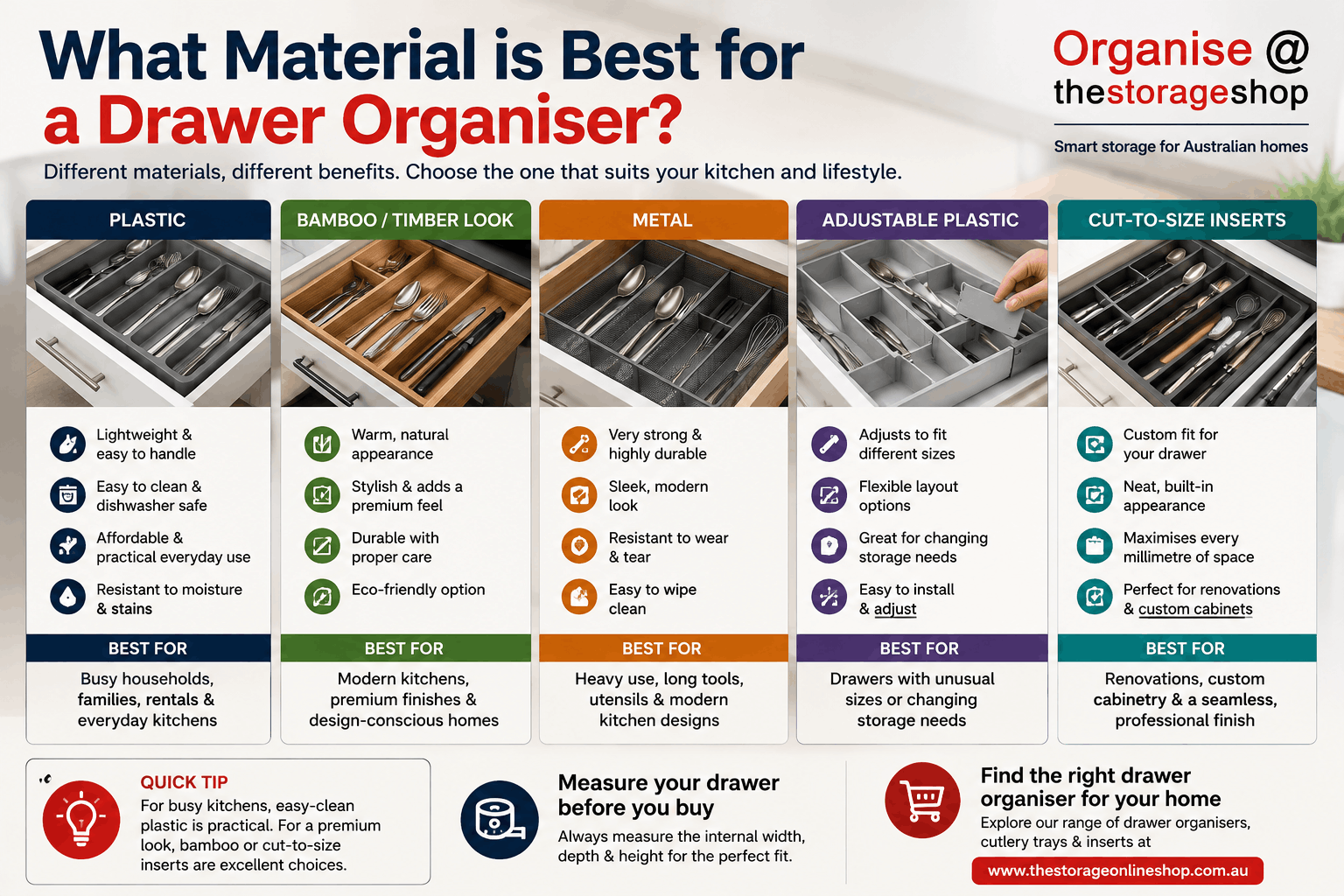
A quick note for Australian homes: bamboo handles everyday kitchen life well, but in humid coastal or tropical climates it’s worth drying it properly and avoiding standing moisture, which is what causes timber to mark or warp. If your drawer occasionally cops a spill, a wipe-clean plastic or stainless tray is the more forgiving choice.
How to organise each kitchen drawer
A good layout starts with how often you use each item. Group like with like, then keep everyday things at the front where your hand naturally lands.
- Everyday cutlery drawer. Keep this near the dishwasher, dining area or prep zone. Use a tray with clear sections for knives, forks, spoons and teaspoons, and store only the cutlery you use regularly here — special-occasion sets can live elsewhere.
- Cooking utensil drawer. Use wider sections and group similar tools: spatulas in one area, tongs in another, measuring tools in another. If the drawer struggles to close, that’s your cue to move a few oversized items out.
- Knife and sharp-tool drawer. Sharp tools shouldn’t sit loose. Use a knife dock or protective insert to keep blades separated — it protects both the edges and your fingers.
- Baking drawer. If you bake often, keep measuring cups, spoons, piping tools and small accessories together in their own zones rather than mixing them with everyday cooking tools.
- Wraps and food-storage drawer. Foil, cling wrap, baking paper and freezer bags get messy fast. Long compartments or dividers keep them lined up and easy to grab.
- Household utility drawer. Most homes have one. Use smaller dividers for scissors, tape, batteries, pens and chargers so it doesn’t become a cluttered catch-all.
The drawer organiser brands worth knowing
Choosing a recognised brand is the difference between a tray that lasts years and one that cracks by next winter. A few names come up again and again for kitchen drawers, each with its own strength.
- Madesmart — soft-grip, non-slip cutlery and utensil trays, including junk-drawer and deep-drawer formats. Known for staying put and feeling solid in the hand. See the madesmart range.
- Hafele — European-engineered drawer inserts built to suit standard cabinet sizes, with timber and trimmable options for a built-in finish. Browse Hafele.
- InterDesign (iDesign) — clear and modular organisers that are easy to see into and move between the kitchen and the bathroom.
- L.T.Williams — practical Australian homewares including expandable trays and dividers that flex to fit a range of drawers.
- Bamboo expandable dividers — tool-free, spring-loaded sections for a quick, natural-looking fix.
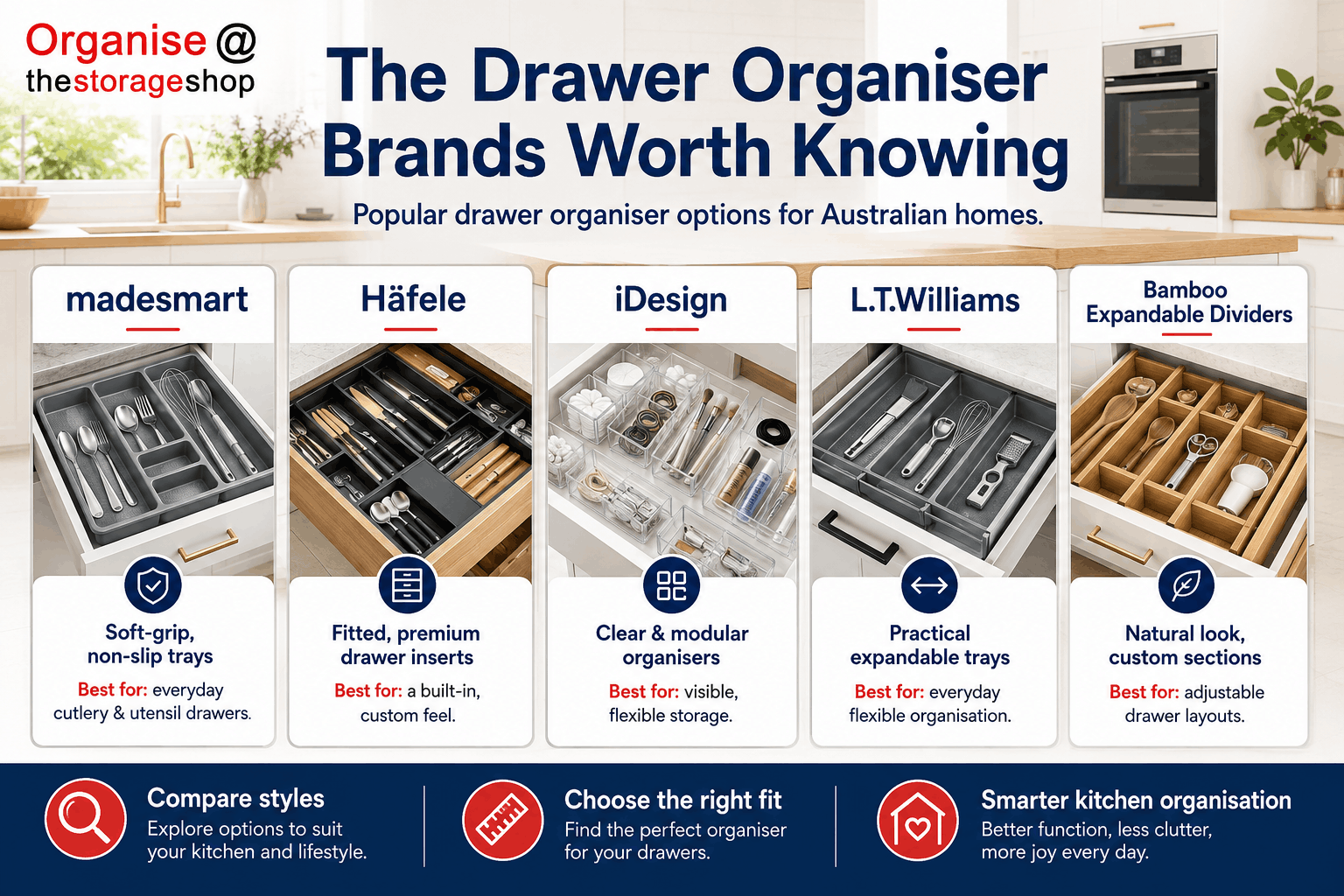
You’ll find these across our drawer organiser range, all sized for Australian kitchens.
Complete kitchen organisation: drawers, cabinets and waste storage
Drawer organisers are one part of a well-planned kitchen. Once your cutlery and utensil drawers are working properly, the next upgrade is what’s hidden inside your cabinets — and the smartest of those is concealing the bin.
The area under the sink is one of the hardest cabinets to organise, since it has to work around plumbing as well as cleaning products and waste. If you’re improving your kitchen storage, read our guide to the best under-sink rubbish bins for Australian kitchens for help choosing a bin that fits your sink cabinet.
Hidden waste storage also makes the whole kitchen feel cleaner. Pull-out bins are popular because they keep rubbish and recycling inside the cabinet while staying easy to access — and, like cutlery trays, they’re sized to the same standard cabinet widths. For options across different cabinet types and budgets, see our guide to the best pull-out kitchen bins in Australia. Together, organised drawers and concealed bins make a kitchen that looks neater and works better every day.
Common drawer organisation mistakes to avoid
Even a good organiser won’t perform if it’s chosen or used poorly. Watch for these.
Buying without measuring. The most common mistake by far — always measure the internal drawer dimensions first.
- Overfilling one drawer. If a drawer is crammed, the organiser can’t do its job. Cull duplicates and rarely used gadgets.
- Choosing the wrong layout. A cutlery tray isn’t right for big utensils. Match the layout to what you actually want to store.
- Ignoring height. Some trays fit in width and depth but sit too tall once items are added. Check the clearance.
- Mixing unrelated items. Cutlery, batteries, takeaway menus and random bits in one drawer defeats the purpose. The more focused the drawer, the easier it stays.
- Forgetting to clean. Lift the tray out occasionally, wipe the drawer base, and clean the organiser before everything goes back.
How often should you reorganise kitchen drawers?
Review your drawers every few months, especially in a busy household — you rarely need a full overhaul, just a quick check. Pull out anything that doesn’t belong, wipe the tray, look for duplicates, and make sure the layout still suits your routine.
If your habits change, the drawer can change too. Start baking more and you might want a dedicated baking drawer; buy new utensils and you may need a wider insert or an extra divider. The best system is one that keeps up with real daily use.
Why choose The Storage Online Shop for drawer organisers?
The Storage Online Shop offers practical home storage solutions for Australian homes — across kitchen storage, drawer organisation, waste storage, laundry, wardrobes, bathrooms and garages. For kitchens, that means helping you build cleaner, more functional spaces with cutlery trays, drawer organisers, kitchen bins, under-sink bins and pull-out bin systems.

You can browse the full kitchen drawer organiser range online and compare options by space, storage need and kitchen layout, so you find a practical fit without guessing. The Storage Online Shop offers convenient online shopping and Australia-wide delivery options.
It’s a useful choice for homeowners improving everyday storage, renovators planning better cabinet organisation, cabinet makers after practical fittings, apartment owners working with limited drawers, and families who want a neater, easier kitchen routine.
FAQs about drawer organisers in Australia
What size cutlery tray fits a 600mm drawer?
A 600mm base cabinet usually leaves roughly 520–560mm of internal drawer width, which comfortably fits a full cutlery tray alongside a separate utensil tray, or a modular clip-together set. Internal sizes vary by drawer system, so always measure the inside of the empty drawer before buying.
How do I choose the right cutlery tray for my drawer?
Measure the internal width, depth and height of the empty drawer, then pick a tray that fits those numbers with a little room to spare. Choose the compartment layout based on what you store — narrow sections for cutlery, wider ones for cooking tools.
How do I stop a drawer organiser from sliding around?
Choose a tray sized close to the drawer so it has less room to move, then add grip underneath — a strip of non-slip drawer liner, a rubber mesh mat, or a few self-adhesive felt pads. Some trays include built-in non-slip feet, which removes the problem entirely.
Can I cut a cutlery tray to fit my drawer?
Yes — trimmable trays are made for this. They have score lines or trim zones along the ends so you can shorten them to your exact internal width with a saw or sharp blade. They’re the neatest answer for odd or in-between drawers. Always measure and mark before you cut.
What’s the best way to organise a deep kitchen drawer?
Deep drawers suit taller trays, caddies and modular sets that use the vertical space. Keep heavier, everyday items toward the front for easy reach, and use the depth at the back for bulkier or less-used tools. A cutlery tray combined with dividers usually beats one large open tray.
Do drawer organisers work in odd or non-standard drawers?
Yes. Expandable trays widen to fill the gap, trimmable trays cut down to size, and spring-loaded tension dividers fit almost any width. Measure the interior first, then choose a format built to adapt rather than a fixed tray.
Can drawer organisers be used outside the kitchen?
They can. The same trays and dividers tidy bathroom vanities, home-office desks, bedroom dressers, laundry drawers, caravans and garage storage. Clear inserts suit small bathroom items, while modular sections are ideal for craft and hobby drawers.
Where can I buy drawer organisers in Australia?
You can shop cutlery trays, drawer inserts and kitchen drawer organisers online at The Storage Online Shop, which offers convenient online shopping and Australia-wide delivery options.
Shop drawer organisers, cutlery trays & inserts in Australia
A neat kitchen starts with storage that works. The right cutlery tray or drawer insert keeps utensils and tools in their place, so everyday cooking and cleaning feel easier — whether you’re updating one drawer or planning a full kitchen storage upgrade. Measure your drawer, pick your format, and explore drawer organisers, cutlery trays and practical kitchen storage at The Storage Online Shop to create a kitchen that’s cleaner, smarter and easier to use every day.