
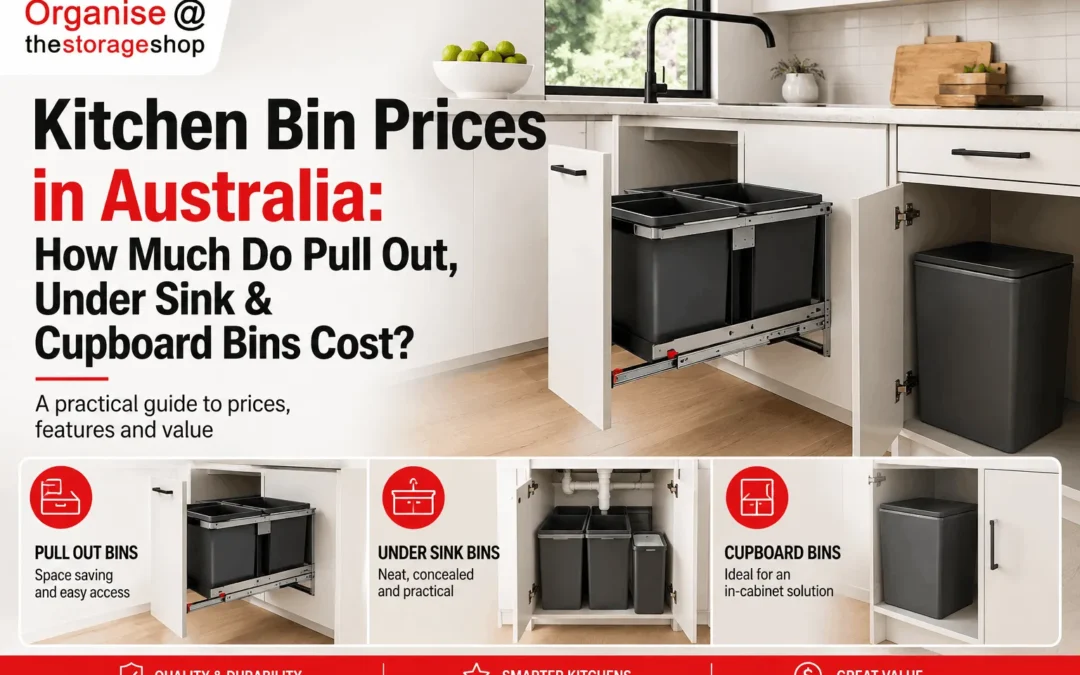
The short answer: kitchen bins in Australia cost from $80 for a compact door-mounted bin to $700 for a premium drawer-integrated system. Most households fitting a bin inside a cabinet spend $150 to $400. Compartment count and runner quality move the price far more than bucket size does.
A kitchen bin can cost under $100 or close to $700, so it is fair to ask what the extra money buys. In Australia the answer is rarely capacity. Cabinet fit, runner quality, mounting style and the level of cabinetry integration drive the price far more than litres do.
If you are comparing kitchen bins for a new kitchen, a renovation or a straightforward storage upgrade, start with your cabinet space and how your household handles rubbish and recycling. A bin that suits your routine and your cabinetry is better value than the cheapest option or the largest one.
This guide sets out what kitchen bins cost in Australia, where the extra money goes, and what each budget realistically buys.
How Much Do Kitchen Bins Cost in Australia?
Concealed kitchen bins start around $80 for compact door-mounted units. Pull-out systems occupy the middle of the market. Premium drawer-integrated systems reach $450 to $700 depending on hardware, capacity and configuration.
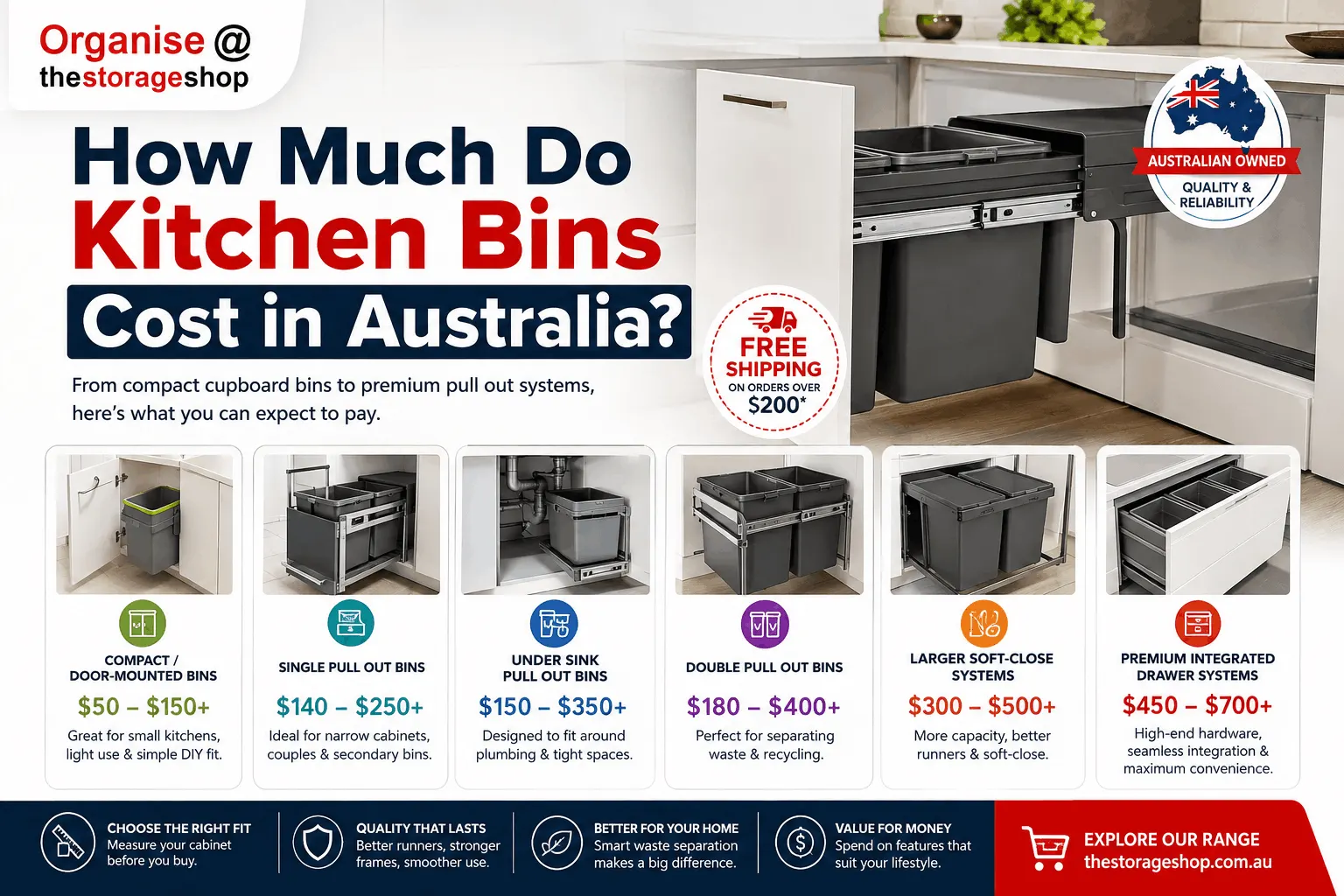
| Kitchen bin style | Price range | Typically suits |
| Compact cupboard / door-mounted bin | $80 – $180 | Small kitchens, light waste, quick DIY fit |
| Single pull-out bin | $140 – $250 | Narrow cabinets, couples, second bins |
| Under-sink pull-out bin | $110 – $320 | Working around sink plumbing |
| Double pull-out bin | $180 – $350 | Waste and recycling separation |
| Larger soft-close system | $300 – $500 | Families and busy kitchens |
| Premium integrated drawer system | $450 – $700 | Renovations and high-end cabinetry |
Note: These are buying-guide ranges, not fixed market prices. Promotions and availability change, so check the individual product listing before ordering.
Price guide checked: August 2026.
Some Context on What Goes in the Bin
| Figure | Value |
| Food wasted across the Australian supply chain each year | 7.6 million tonnes |
| Share created in Australian homes | 2.5 million tonnes (34%) |
| Cost to the Australian economy | $36.6 billion per year |
| Wasted food per household, per year | $2,000 – $2,500 |
| Food waste per person, per year | 312 kg |
Source: Department of Climate Change, Energy, the Environment and Water, drawing on the National Food Waste Baseline and Strategy Feasibility Study.
That household figure is about one grocery bag in five. A bin does not solve food waste on its own, but a setup that makes separating scraps effortless rather than annoying is one of the few kitchen purchases with a real case for paying for itself. Against a four-figure annual number, the gap between a $150 bin and a $350 one looks smaller than it does in isolation.
Why Do Two Similar Kitchen Bins Have Very Different Prices?
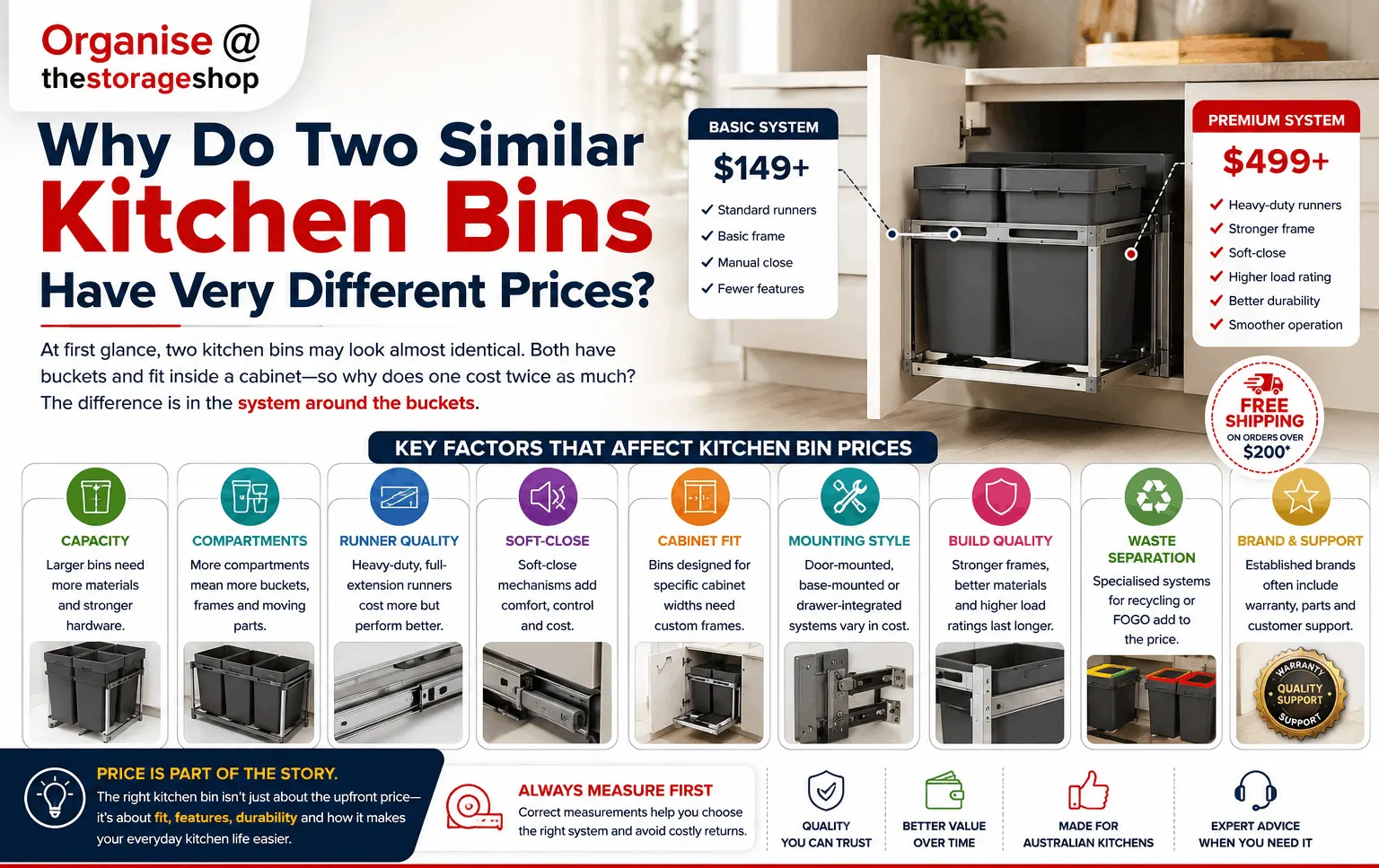
Two bins may look almost identical — two buckets, both fitting inside a cupboard — while one costs twice as much. The difference sits in the system around the buckets.
- Capacity
A compact 15L or 20L bin uses less material and lighter hardware than a 60L or 70L system. Larger bins also need frames and runners that carry more weight when loaded.
Match capacity to your household rather than your budget. A larger bin is not better if it consumes cabinet space you need elsewhere.
- Number of Compartments
Single bins are simpler and cheaper. Double and triple systems let you separate general rubbish, recycling and food scraps without scattering freestanding bins around the kitchen.
Each extra compartment adds a liner, a wider frame and more hardware — and adds to the price. It also removes a bin from your floor, which is usually the better trade in a small kitchen. Our guide to pull out, under sink and cupboard kitchen bins explains how the designs differ, and kitchen rubbish bins Australia: types and sizes maps configurations against council collection streams.
- Runner and Frame Quality
The sliding mechanism is the most important part of a pull-out bin, and often the largest single cost in it.
A kitchen bin gets opened dozens of times a day, carrying weight while it does. Full-extension runners let you reach the rear bucket. Soft-close stops it slamming. A higher load rating stops it sagging in year three. These parts are invisible next to the bucket, and they decide whether you still like the bin in year six.
- Cabinet Integration
A frame-mounted pull-out system is a different product from a bin built into a complete drawer. Integrated bins include drawer hardware, mounting components and specialised cabinet fittings, so you are buying the whole sliding storage mechanism rather than the waste containers.
How Much Does a Pull Out Kitchen Bin Cost?
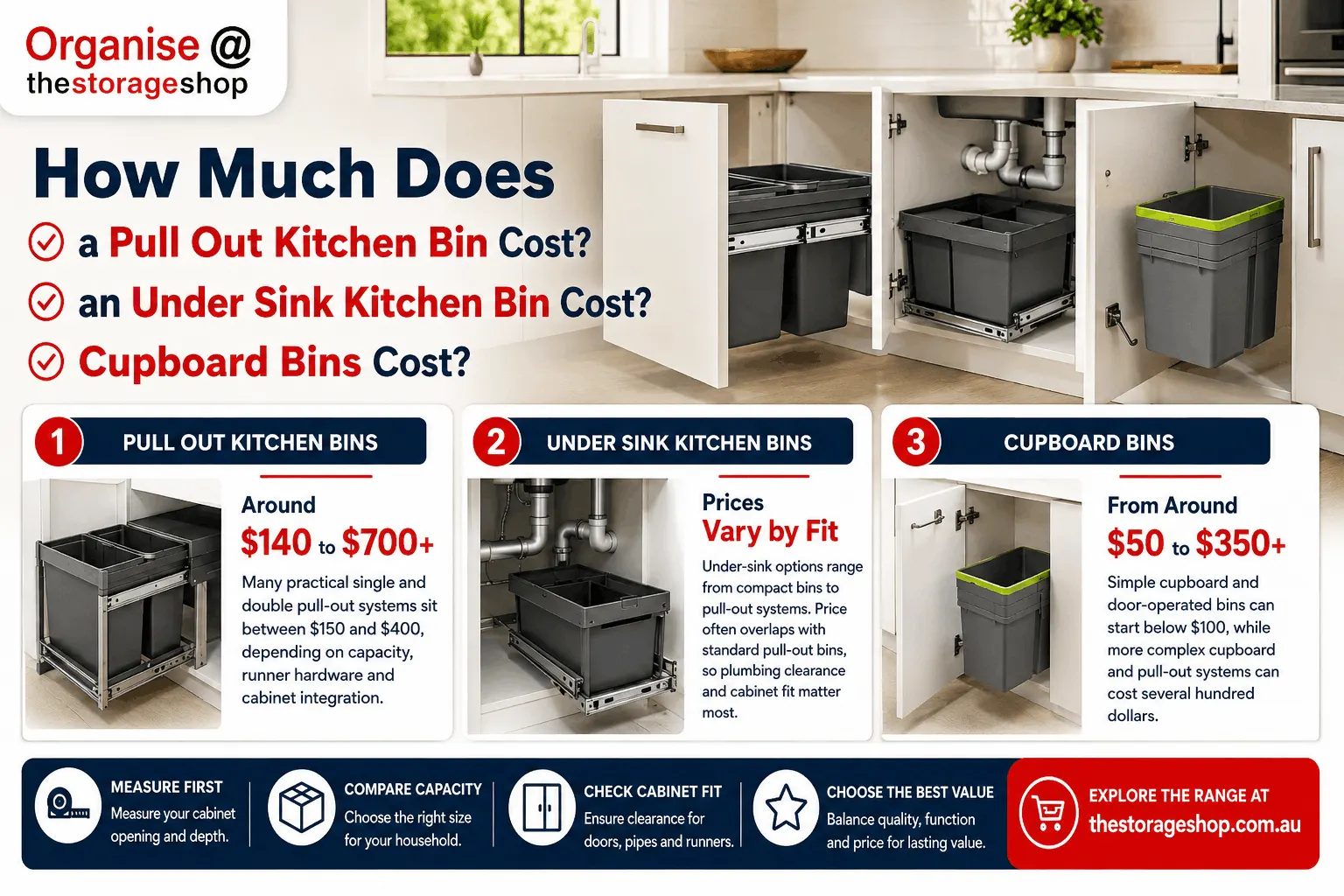
Pull-out kitchen bins cost $140 to $700 in Australia. Most households land between $150 and $400. Singles sit at the bottom of that range; multi-compartment systems with full-extension soft-close runners sit at the top.
- $140 to $250
This budget covers practical concealed waste storage without paying for drawer integration. Depending on the model you get single or double buckets, compact to medium capacities, a sliding frame, removable buckets and the option to separate waste from recycling.
For model-by-model comparisons rather than price bands, see our best pull out bins guide. Browse the full range in pull out bins.
- $250 to $400
This range opens up larger capacities, soft-close mechanisms and multi-compartment configurations.
For a family kitchen, spending here usually pays off when it lets you combine general waste and recycling inside one cabinet rather than surrendering floor space elsewhere.
- $400 and Above
At this level the money goes to premium hardware and cabinetry integration. These systems suit a full renovation, where the bin has to work as part of the kitchen design rather than as something added afterwards.
Brands like Wesco, Hideaway and Kosara price in longer warranties and parts availability at this end. When a liner cracks in year four, a brand that still stocks the part saves you replacing the whole unit.
How Much Does an Under Sink Kitchen Bin Cost?
Under-sink bins cost $110 to $320.
| Configuration | Price range |
| Single compartment | $110 – $200 |
| Slim or narrow-cabinet fit | $150 – $260 |
| Double compartment | $180 – $320 |
They sit slightly below equivalent standard pull-outs because they are built shorter and narrower to clear the plumbing. You also get ten to twenty litres less than the same cabinet width would hold elsewhere. Where the sink cabinet is your only free cabinet, that is a fair trade.
Price should not be your first filter here. The space beneath a sink is rarely an empty rectangle: the bowl, waste trap, pipework, valves and any water filtration all reduce usable width, depth and height. A $150 bin that clears your plumbing is a far better purchase than a $110 bin that cannot open fully.
Before comparing prices, measure:
- Internal cabinet width
- Usable cabinet depth
- Height from cabinet base to the lowest obstruction
- Position of the waste trap and pipes
- Door hinge clearance
- Space the runners need to extend
Photograph what is actually under there and check it against the product’s clearance dimensions. This mismatch is the most common reason an under-sink bin gets returned.
Our under sink pull out bin buying guide goes deeper on selecting around plumbing, and our best under sink rubbish bins picks narrow the shortlist. Browse under sink bins directly.
How Much Do Cupboard Bins Cost?
Cupboard bins cost $80 to $350, depending on which design you mean — the term covers several.
| Type | Price range |
| Door-mounted bin (fixed to the cupboard door) | $80 – $150 |
| Swing-out cupboard bin | $120 – $180 |
| Frame-mounted pull-out cupboard bin | $180 – $350 |
Door-mounted bins are the cheapest way to get rubbish off the kitchen floor, because there is no runner hardware in the price — a bracket and the door do the work. They also install fastest, usually inside half an hour.
The trade-offs are capacity and load. The weight hangs off the door hinges, so if your cupboard door already drops slightly when open, adding several kilos of rubbish will not help. Larger pull-out cupboard bins cost more because the price includes runners, a supporting frame and additional hardware.
A cupboard bin works well when you want easy access near the food-preparation area without a large waste capacity. Browse door mount bins.
Does Cabinet Width Affect Kitchen Bin Price?
Yes, though not as simply as “wider cabinet, dearer bin.”
Cabinet width determines which systems physically fit. The configuration you then choose determines the cost. A premium system for a 300mm cabinet can cost more than a basic system for a 600mm one, because hardware and integration matter more than width.
Always compare the internal measurements a product requires rather than ordering to your cabinet’s nominal size. Our cabinet width guide for pull out bins walks through measuring properly and shows which configurations suit 300mm through 600mm cabinets — worth two minutes, because size errors cost freight in both directions.
What Do You Get at Each Price Point?
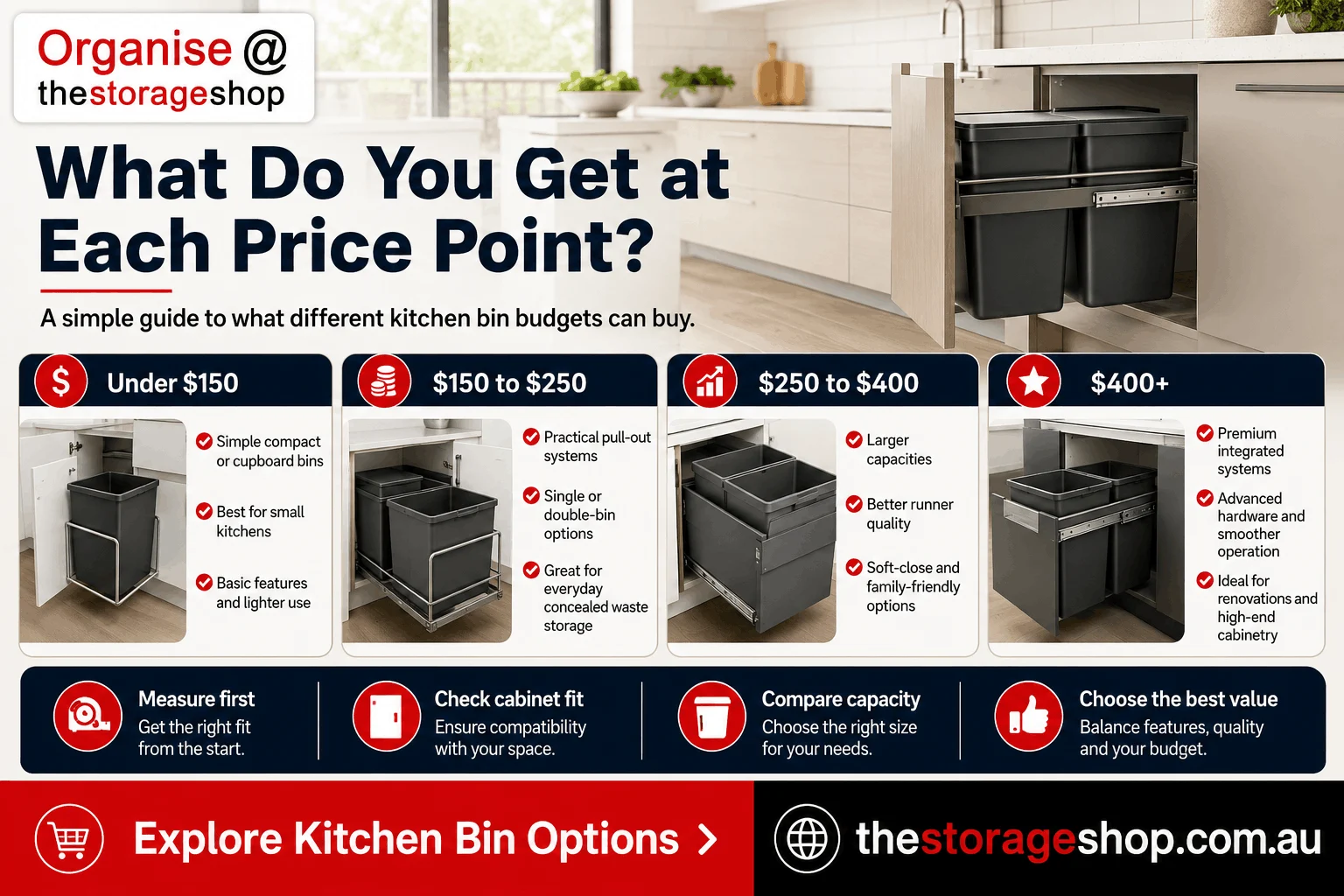
- Under $150
Prioritise simplicity and correct fit. This level suits a small household, an apartment, a secondary waste station, or a cupboard where high capacity is unnecessary. Expect basic runners or a door-mounted design.
- $150 to $250
The widest selection of practical pull-out systems sits here, including double-bin configurations. It covers concealed waste storage and basic recycling separation without paying for premium cabinetry hardware. This is where most Australian households end up.
- $250 to $400
Larger capacities, better pull-out mechanisms, soft-close operation and configurations built for daily family use. If several people use the kitchen every day, the extra capacity and smoother access earn their keep.
- $400 and Above
Most relevant to renovations, premium cabinetry and highly integrated storage. Do not spend here because a system costs more — spend here because its capacity, hardware and mounting style genuinely suit your kitchen.
The pattern worth knowing: the step from budget to mid-range changes how the bin feels every day. The step from mid-range to premium mostly changes how long it lasts and how it looks. Behind a cupboard door, the first step is the one that pays.
Do Kitchen Bin Prices Include Installation?
The displayed price covers the bin system itself. Installation depends on the model and your existing cabinet.
A base-mounted pull-out system is manageable for a confident DIY homeowner. Door-connected and drawer-integrated configurations need more careful alignment. The job gets more involved when cabinetry needs altering or when sink plumbing restricts where the frame can mount.
If you would rather not do it yourself, budget roughly:
- Handyman, straightforward fit: $80 to $150. Airtasker’s 2026 cost data puts sub-one-hour handyman jobs in that band, and $150 to $300 for one to three hours.
- Cabinetmaker, where the cabinet needs modifying: $150 to $350.
- During a kitchen build: often folded into the cabinetry quote — but ask. Supply-and-install margins on hardware can be steep, and buying the bin yourself for your cabinetmaker to fit frequently costs less.
Factor installation in when comparing two products. A cheaper unit that forces cabinet modifications is not the cheaper unit.
Can You Install a Pull Out Kitchen Bin Yourself?
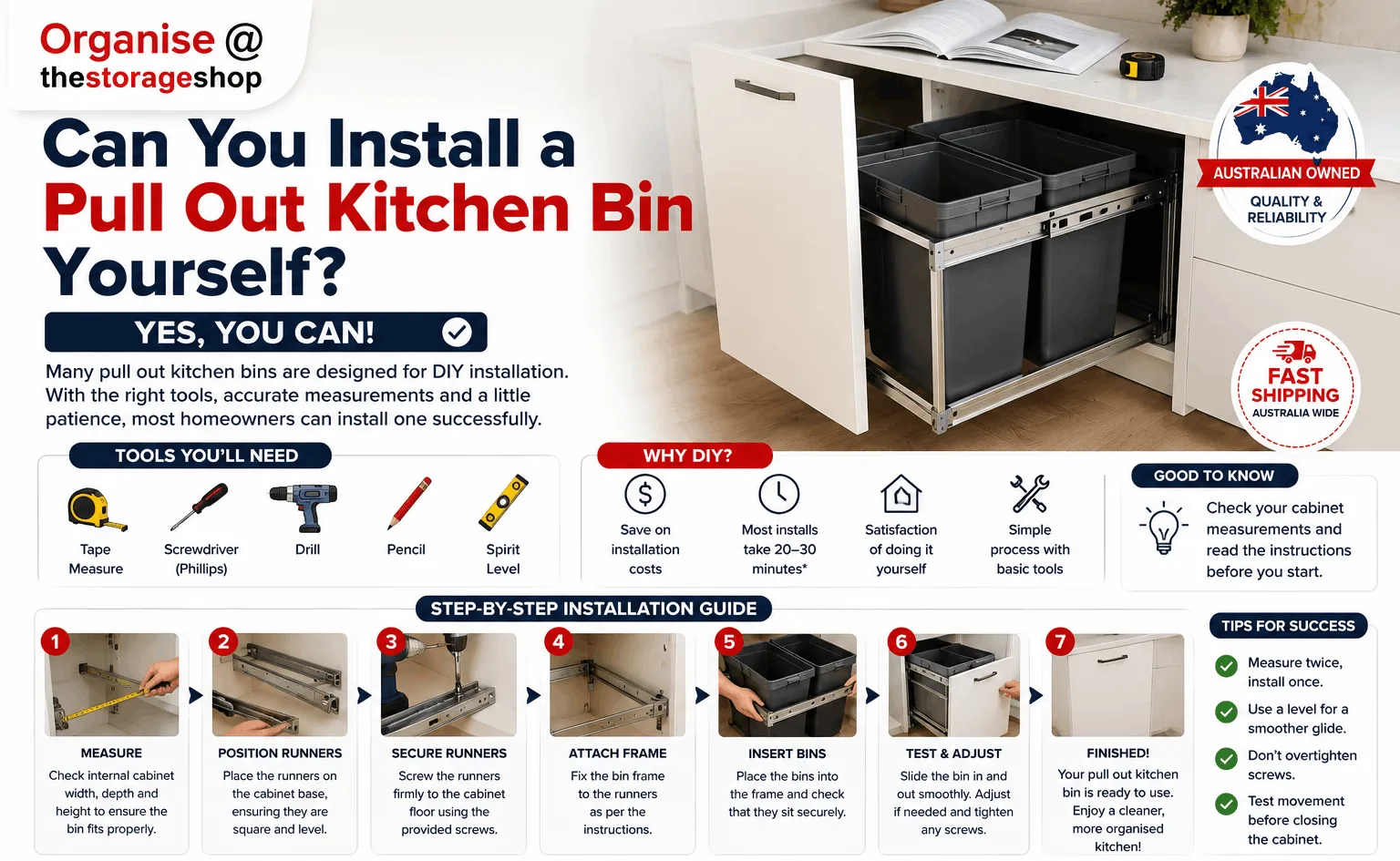
In most cases yes, if you are comfortable measuring accurately, drilling into cabinetry and aligning runners. Door-mounted bins are quickest; side-mounted pull-outs take longest. Budget thirty to sixty minutes.
Read our step-by-step guide to installing a pull-out kitchen bin before booking anyone. It covers preparation, measurements, positioning and each installation stage, so you can judge whether this is a job you want to take on.
The Costs That Are Not on the Price Tag
- Freight. Bins are bulky and light, the expensive combination to ship. Check the quoted price reaches your postcode, especially outside metro areas.
- Return shipping. Order the wrong size and you generally pay freight both ways.
- Replacement liners. Plastic cracks eventually. Confirm spares exist for the model — a bin with no available parts is a bin you replace whole.
- Bin bags. Odd compartment sizes push you onto non-standard bags you will reorder for a decade. A unit taking supermarket sizes quietly saves money.
- Cabinet modification. A centre stile or fixed shelf that has to come out is an extra job, sometimes an extra trade.
Is a More Expensive Pull Out Kitchen Bin Worth It?
Sometimes, but not automatically.
Paying more is worthwhile when the extra cost buys something you will use:
- Capacity that matches your household
- Stronger, smoother, full-extension runners
- Soft-close operation
- Better waste separation
- Easier bucket removal
- A configuration that fits your cabinet properly
- Integration into a renovated kitchen
A couple producing little household waste gains little from a large premium system. The best-value kitchen bin solves your storage problem without charging you for capacity or features you do not need.
Put simply: spend on the runners, economise on the finish.
How Should You Choose a Kitchen Bin for Your Budget?
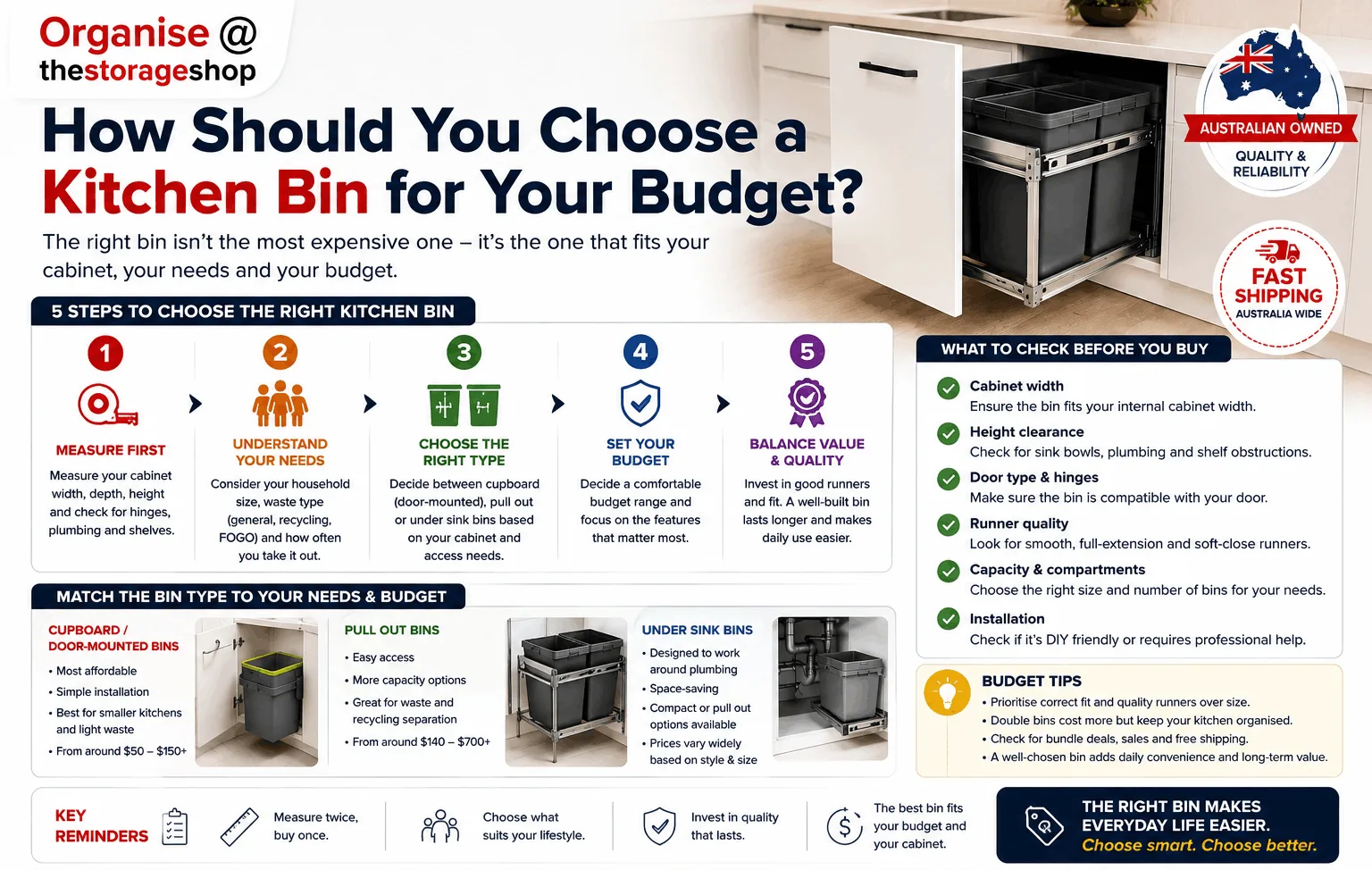
Start with the cabinet, not the price tag.
Identify where the bin will go and take accurate internal measurements. Decide how many waste streams you separate — check your council’s collection page, because a FOGO rollout adds a third stream and changes which price band you are shopping in. Then estimate the capacity your household needs. Only then compare price.
- Measure the available cabinet space.
- Check plumbing and hinge obstructions.
- Choose single, double or triple compartments.
- Decide how much capacity your household needs.
- Compare compatible products by price and features.
- Check installation requirements before ordering.
This sequence avoids both traps: the bargain that does not fit, and the several hundred dollars you did not need to spend.
How We Put Together This Kitchen Bin Price Guide
The price guidance here is based on kitchen-bin products available through The Storage Shop in Australia in August 2026.
We looked across compact bins, pull-out systems, multi-compartment solutions and premium integrated drawer systems to show how capacity, cabinet configuration and hardware change the purchase price. Because promotions and availability change, treat these figures as indicative and use the individual product page for the latest price, dimensions and specifications.
Why Choose The Storage Shop?
We supply concealed kitchen-bin systems to Australian homeowners, renovators and trade customers, and we stock brands including Wesco, Hideaway and Kosara.
The practical difference is how you can compare. Rather than sorting by litre capacity alone, you can compare products by cabinet dimensions, mounting style, compartment count and everyday functionality. That matters most with narrow cupboards, under-sink plumbing and renovation cabinetry, where a few millimetres decide whether a system fits.
If you are unsure which option suits your cabinet, measure before you shop. It makes comparing the range far easier — and it is the single best defence against a return.
Frequently Asked Questions About Kitchen Bin Prices
How much does a pull out kitchen bin cost in Australia?
Pull-out kitchen bins cost $140 to $700, with most households spending $150 to $400. Single-compartment units start around $140, doubles run $180 to $350, and premium drawer-integrated systems reach $450 to $700. Capacity, compartment count, runners, soft-close hardware and cabinet integration set the final price.
Are under sink bins cheaper than pull out bins?
Slightly. Under-sink bins cost $110 to $320 against $140 to $700 for standard pull-outs, because they are built smaller to clear the plumbing. You get fewer litres for the money, so they suit kitchens where the sink cabinet is the only available space.
Why are some kitchen bins over $450?
Higher-priced systems include premium drawer hardware, stronger runners, soft-close mechanisms, larger capacities and cabinetry-integrated components. At that level the price represents an entire sliding storage system rather than the waste buckets alone.
How much should I spend on a kitchen bin?
For a cabinet-mounted bin in a home you are staying in, $150 to $350 is where soft-close runners and a proper load rating become standard. Below that you compromise on hardware. Above it you mainly buy finish, brand and warranty.
Is a double kitchen bin worth paying extra for?
Yes, if you separate general rubbish and recycling — which most Australian households do, because kerbside collection is split. A double keeps both streams in one cabinet and removes the need for a second freestanding bin.
Does kitchen bin capacity affect price?
Larger systems cost more, but capacity is only one factor. A smaller bin with premium drawer hardware or specialised mounting costs more than a larger basic frame-mounted unit.
How much does it cost to install a pull out bin?
Nothing if you install it yourself, and most take thirty to sixty minutes. A handyman charges $80 to $150 for a straightforward fit, and a cabinetmaker $150 to $350 where the cabinet needs modifying.
Should I buy the cheapest kitchen bin that fits?
Fit is essential, but weigh it against how often the bin gets used, runner quality, capacity and whether replacement parts are available. A slightly higher price delivers better everyday value when the system suits your kitchen more closely.
Compare Kitchen Bins for Your Space and Budget
Kitchen bin prices vary widely because these products solve different problems. A compact cupboard bin, a double pull-out and a fully integrated drawer bin should not be compared on price alone.
Measure your cabinet, work out how your household handles waste and recycling, decide which features matter, then compare compatible products within your budget. If you are still choosing between types, our complete guide to kitchen bins covers each design, and our kitchen bin ideas piece helps if the bin will be on show.
Explore our range of pull out, under sink and cupboard kitchen bins to compare current prices, capacities, cabinet requirements and configurations.